....Emmeline wanted to forget
What does it feel like to be born into the Pankhurst family? As the youngest of three daughters, the expectations of Adela Pankhurst (1885–1961) were set before she had even been born. Her eldest sister Christabel was her mother Emmeline’s favourite and her partner in the suffragette movement. The second daughter Sylvia, as an artist, designed the logo and banners for the WSPU and protested alongside her family until her socialist views led her to part from them. But it was Adela whose choices caused Emmeline to send her away not once but twice, at the age of 11 to Aberdeen to live with her aunt, and again at 29, this time with a one-way ticket to Australia. Emmeline didn’t mention her youngest daughter once in her autobiography, and even her sister Christabel apparently claimed
“I would not care if [Sylvia] were multiplied by a hundred, but one of Adela is too many.”
So what was it about Adela that became too much for her suffragette family?
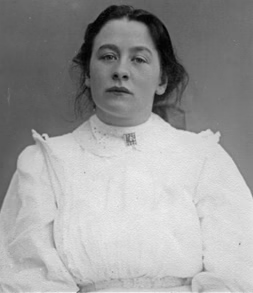
Adela’s views were influenced by the suffering she witnessed among the people who had nothing. Having received a high-quality education at Manchester High School for Girls like her sisters, she went to the Disley Road school as a trainee teacher, where she saw first-hand the effects of poverty on children. She started to focus her efforts on doing what she could to stop their suffering, including - but not limited to - getting women the vote. She became a paid organiser for her mother’s union the WSPU, working especially in northern towns such as York and Scarborough, where she met a lot of working class women, further developing her passion to improve conditions for them.
She did not break away from her family to pursue socialism straight away. In 1907 she and Jessie Kenney formed the Young Hot Bloods, a secret branch of the suffragettes who were on “danger duty.” This gave them the task of sourcing flammable material and house-breaking tools for violent protests. Adela was imprisoned several times for her own involvement in protesting: in 1906 for disrupting a Liberal Party meeting and in 1909 at a talk of Churchill’s where she slapped the policeman who evicted her from the building. During her imprisonment at Strangeways in Manchester she went on hunger strike, a medical supervisor assessing her
“heart’s action as violent and laboured.”
She also returned to Aberdeen to support the Scottish suffragette movement alongside Helen Fraser, who stayed a friend for life. In 1910, like many other members of the movement, she was invited to plant a Himalayan Cedar at the suffragette refuge Eagle House, and she received a Hunger Strike Medal ‘for Valour.’ So far so suffragette. Interestingly however, a police officer assigned to uncover Young Hot Bloods commented that
“these are not the women who would get the vote … They own no property, and are not married women.”
Through this group Adela was joining forces with lower class women who were angry and unsupported by the majority of the suffragette movement, which focused mainly on votes for middle-class women.
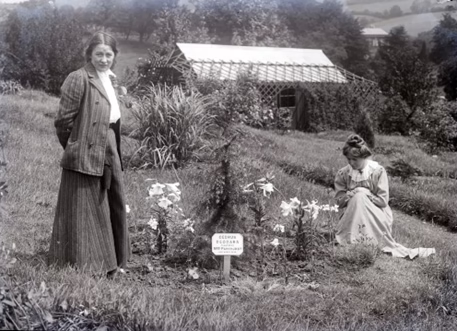
Adela started to have doubts about the WSPU. She no longer agreed with their militant stance and was noticing class disparities within the movement: militancy exacted a far heavier toll on working-class women than on the middle-class who had financial and social protection, with the former receiving worse treatment in prison. Meanwhile in London her sister Sylvia’s socialist views led her to form her own organisation to support working-class families. Both Adela and Sylvia were expelled from the WSPU by their mother, but it was Adela who was then sent to the other side of the world with £20, never to see her family again. On her arrival in Melbourne she apparently declared
“You have heard a great deal about broken windows. I can tell you about the broken lives that caused the broken windows.”
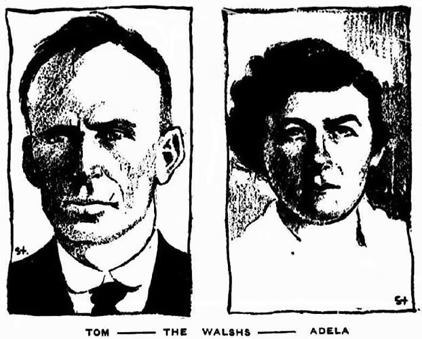
Adela arrived in Melbourne in 1914 to be met by Vida Goldstein, a suffragist who had stood as one of the first female candidates in the 1903 federal election. With the suffragette goal already achieved here, it was pacifism to which Adela turned her efforts. She joined the Women’s Peace Army, writing anti-war pamphlets and a book called ‘Put Up the Sword’, touring both Australia and New Zealand to speak against war and conscription. Through her campaigning she met the Trade Unionist Tom Walsh, together
“they hated the wicked loss of life and feared that the cost of the war would prove a barrier to future improvements in the workers’ standard of living” (Hogan).
Adela was prosecuted several times, and the Australian Prime Minister Billy Hughes was so keen to reign her in that he offered to commute a prison sentence if she promised never to give a speech again. This rebel Pankhurst of course refused, and so was forced to return to jail weeks after marrying Walsh during her bail term. On hearing of Adela’s actions from across the world, Emmeline actually telegraphed Billy Hughes denouncing her daughter, which seemed to encourage Adela more: she wrote to Sylvia
“This is the life, isn’t it, and I am very happy.”
When the war ended in 1918 the fight for pacifism was no longer relevant and Adela found herself causeless again. This was when she turned to communism, founding the Communist Party of Australia in 1920, planning for communal kitchens and free books. It seems she was fuelled with anger at the slaughter of WW1 and wanted justice particularly for the working class, a determination she had brought with her from her experiences back in the UK. Almost as soon as she founded this movement, however, she became disillusioned with its ideology and left the party after just three years. Her husband even admitted to attending only two party meetings. She claimed that the party
“prioritised the international business of Soviet Russia … [over] the welfare of the workers of Australia” (Price).
This anger against Russia would perhaps lead to some of her more worrying political franchise views.
Now that Adela had found her new ideology, she set up yet another party in 1928, this time the anti-communist Australian Women’s Guild of Empire. Still determined to raise money for working-class women and children, she now spoke out against strikes, believing that
“the correct response to the Depression was to increase efficiency and raise productivity” (Hogan).
She prioritised safeguarding the family, denouncing contraception, abortion and nursery schools as detrimental to maternal values. She even wrote to her mother to say that she and her husband had changed their minds about socialism.
It was in the late 1930s that things started to turn from rebellious to controversial. In 1939 Adela visited and fell in love with Japan; her ideals moved to the far-right as she began to embrace fascism, anti-Semitism and to advocate for Japan as a better trading partner than America. She also sympathised with Germany as the
“underdog dominated by Britain and France.” (Rizzetti)
The party she founded for this phase of her life was the fascist Australia First Movement, which lasted less than a year due to a series of wartime arrests. When Japan bombed both Pearl Harbour and Darwin in 1942, she was arrested and imprisoned for her pro-Japanese sentiments. This was the moment her reputation was ruined, and although she secured an early release through hunger-striking, she withdrew from public life following her husband’s death in 1943. She had one conversion left: in 1960, just a year before she died, she became a Roman Catholic.
The plaque at Adela’s grave reads
‘A Champion for Women’s Rights in Australia. Wife of Tom Walsh. Daughter of Emmeline Pankhurst.’
Although all true, this doesn’t begin to cover the constantly shifting, contradictory and controversial life she led. Having been brought up in a house determined to change the world for the better, it seems she wanted to find her own purpose, and was repeatedly influenced by place and situation. Perhaps the rejection she suffered from the WSPU and her mother, and her forced emigration, caused her to lead a life of dramatic extremes: abandoning each ideology and looking for a new one each time she lost interest. Just like her mother and sisters, she was clearly a woman of strong conviction and determination, if not consistency; what never changed was her need to act.
© Harriet Hoath 2025
Unearthing the Suffragette Spirit Project
BIBLIOGRAPHY
‘Wayward Suffragette’ - Jeff Sparrow, The Guardian 2015
‘Adela Pankhurst: The Wayward Suffragette’ review - Janine Rizzetti www.residentjudge.com 2017
Australia Dictionary of Biography - Susan Hogan 2006
Adela Pankhurst: Ladies in the House - History Detective Podcast 2022
National Library of Australia
The Pankhurst Museum, Manchester
‘The Pankhurst sister sent from Aberdeen to Australia’ - Neil Drysdale, The Press & Journal 2020
historic-uk.com - Thomas Price 2025
