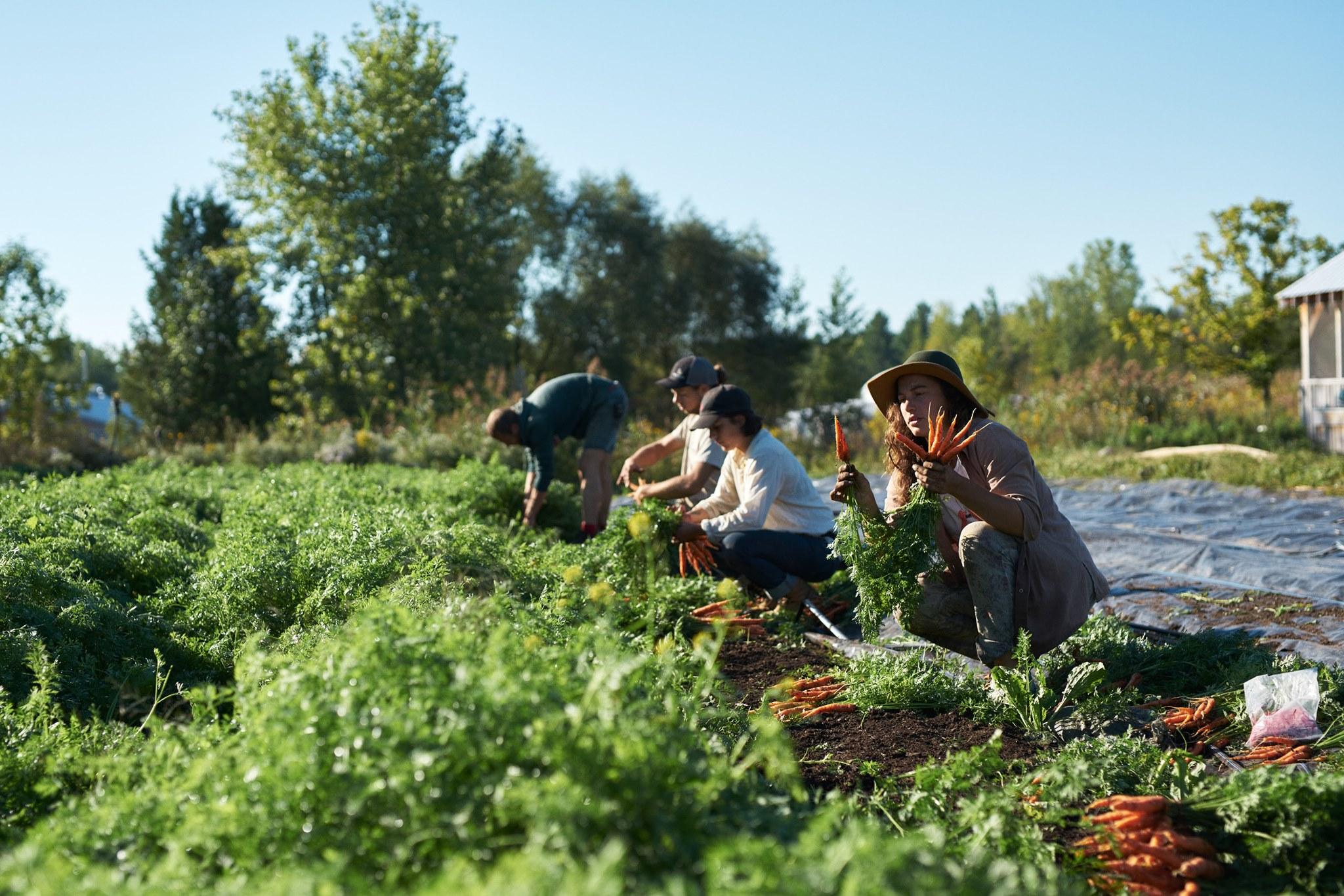
Across North America, Europe, and around Earth, a quiet revolution is taking place on small plots of land. At the center of this movement toward localized, biologically intensive, and highly profitable agriculture is The Market Gardener, an educational and cultural hub founded by French-Canadian farmer, author, and educator Jean-Martin Fortier (JM Fortier) and his partner, Maude-Hélène Desroches.
Originating from their flagship farm, Les Jardins de la Carotte and later Les Jardins de la Grelinette in Eastern Quebec, The Market Gardener project has grown into an international movement. It provides small-scale growers with the tools, operational frameworks, biological techniques, and business models required to turn small plots of land—often under two acres—into commercially viable, high-yielding, ecologically sound agricultural enterprises.
By replacing heavy tractors, synthetic chemicals, and capital-intensive machinery with specialized hand tools, biological soil management, human-scale ergonomics, and direct-to-consumer sales, The Market Gardener demonstrates that micro-farming can offer a lucrative, sustainable, and satisfying career path for a new generation of growers.
Human-Scale Operations: Farming exclusively on 1.5 to 2 acres of cultivated land without heavy, expensive tractor machinery.
Biological Soil Care: Minimizing deep tillage to protect earthworm networks, soil micro-organisms, and delicate soil structure.
High Yield Efficiency: Maximizing crop production per square foot through high-density planting and rapid bed turnovers.
Direct-to-Consumer Sales: Capturing 100% of retail margins by selling directly via CSAs, farmers' markets, and local restaurants.
Financial Viability: Achieving high profit margins with minimal capital debt, proving that small farms can be commercially successful.
From Passion Project to Proven Blueprint
The story of The Market Gardener began in the early 2000s when Jean-Martin Fortier and Maude-Hélène Desroches established Les Jardins de la Grelinette in Saint-Armand, Quebec. Operating on just 1.5 acres of cultivated land, their goal was clear yet ambitious: prove that a family could earn a comfortable living from a small micro-farm while maintaining a balanced lifestyle, nurturing the soil, and avoiding massive debt burdens.
In an industry dominated by industrial consolidation—where farmers are frequently advised to "get big or get out" by buying hundreds of acres and accumulating millions in equipment debt—Les Jardins de la Grelinette chose the opposite direction: grow better, not bigger.
By focusing on high-value crops, bio-intensive bed planning, season extension, and direct sales through Community Supported Agriculture (CSA) subscriptions and local farmers' markets, the farm achieved extraordinary results. On under two acres, the farm generated over $150,000 (CAD) in gross revenue per year with profit margins exceeding 40%—figures virtually unheard of in conventional monoculture farming.
Industrial Monoculture vs. The Market Gardener Model
Land Area: Industrial operations rely on hundreds of acres, whereas micro-farms operate efficiently on 1 to 2 compact acres.
Capital Debt: Industrial models demand high-horsepower tractors and heavy machinery; the micro-farm relies on low-cost hand tools and low-tech automation.
Inputs & Diversity: Industrial farms prioritize synthetic fertilizers and monocropping, while micro-farms utilize organic compost and grow 40+ diverse crops.
Profit Margin: Industrial commodities yield low margins through middlemen, whereas direct-to-consumer micro-farming yields high margins.
The Book That Sparked a Worldwide Movement
In 2012, Fortier published Le Jardinier-Maraîcher, which was translated into English in 2014 as The Market Gardener: A Successful Grower's Handbook for Small-Scale Organic Farming.
Unlike theoretical textbooks, The Market Gardener functioned as an open-source, step-by-step operational manual for micro-farming. It provided exact bed dimensions, planting schedules, financial breakdowns, tool recommendations, and crop profitability matrices. The book sold hundreds of thousands of copies globally and was translated into dozens of languages, serving as a catalyst for thousands of aspiring growers seeking an alternative to industrial agriculture.
The Market Gardener approach is grounded in bio-intensive agriculture—a set of practices designed to maximize biological activity and crop yields per unit of surface area while continuously improving soil health.
1. Permanent Raised Beds & Standardized Geometry
A central innovation taught by The Market Gardener is total standardization of farm layout:
Standardized Bed Dimensions: Beds are laid out in permanent 30-inch (75 cm) widths, separated by 18-inch (45 cm) pathways, typically running 50 or 100 feet in length.
Operational Interchangeability: Because every bed shares identical dimensions, all equipment—from row covers, insect netting, and drip irrigation lines to harvest tarps and specialized hand tools—fits every single bed on the farm interchangeably.
Soil Protection: By keeping foot traffic strictly within the pathways, the growing beds are never stepped on, preventing soil compaction without needing heavy tractor machinery to plow or deep-till the earth.
2. Minimal Tillage & Biological Soil Management
Conventional farming relies on heavy tractor-mounted plows and rotary tillers to invert soil. While this creates a smooth seedbed in the short term, it disrupts earthworm networks, shatters fungal mycorrhizae, burns off organic matter, and exposes buried weed seeds to sunlight.
The Market Gardener methodology replaces mechanical inversion with minimal tillage:
The Broadfork (La Grelinette): A deep-tining hand tool used to aerate and crack subsoil compaction without flipping soil layers or disturbing beneficial soil microbes.
Silage Tarps (Occultation): UV-stabilized black plastic tarps laid over beds for several weeks prior to planting. The dark, warm, humid environment under the tarp germinates weed seeds and starves them of light, while earthworms digest crop residues, creating clean, weed-free seedbeds ready for direct seeding without tilling.
Heavy Composting: Applying a generous top dressing of well-decomposed organic compost directly to the bed surface supplies plant nutrients, feeds the soil food web, retains moisture, and creates a loose tilth for delicate seeds.
3. The Four-Step Minimal Tillage Preparation Process
Step 1 - Crop Termination: Clear or mow prior crop residues from the bed surface.
Step 2 - Tarping (Occultation): Lay black silage tarps over the bed for 3 to 4 weeks to rot down residues and germinate/kill weed seeds in the dark.
Step 3 - Broadforking: Gently crack subsoil compaction using a broadfork without turning or flipping the topsoil layers.
Step 4 - Direct Seeding: Plant seeds directly into a rich, weed-free compost top dressing using precision seeding tools.
How To Start A Small Farm | Complete Guide
4. High-Density Planting & Living Mulches
By planting crops in tight, staggered geometries across 30-inch beds, plant foliage forms an overlapping canopy—a "living mulch"—as crops mature. This dense leaf cover shades out weed seeds, reduces soil moisture evaporation, lowers soil temperature during heatwaves, and maximizes yields per square foot of bed space.
5. Rapid Rotation & High-Value Crop Selection
Micro-farms cannot compete with industrial commodity farms on broad-acre crops like corn, wheat, or potatoes. Instead, The Market Gardener system focuses on high-value, quick-turnover, perishable crops:
Salad Greens & Mesclun Mixes: Harvestable within 21–30 days from seeding, yielding multiple cuts per season.
Root Vegetables: Baby carrots, specialty radishes, and turnips that mature rapidly and command high prices per pound at market.
Fruiting Crops: Greenhouse-grown heirloom tomatoes, seedless cucumbers, and sweet peppers that yield continuously over a long season.
Fresh Herbs: High-margin crops like basil, cilantro, parsley, and dill with minimal weight-to-value ratios.
A major factor in the success of The Market Gardener model is its adoption of specialized hand tools and low-tech automation designed specifically for 30-inch permanent beds. These tools allow a single worker to perform tasks in minutes that previously required hours of manual labor or heavy machinery.
Broadfork (Grelinette): A heavy-duty, two-handled steel fork used for deep subsoil aeration without flipping topsoil layers.
Jang Seeder: A high-precision roller seeder that drops small seeds at exact depths and spacings, allowing rapid bed planting.
Flame Weeder: A multi-burner propane torch passed over beds to destroy emerging weed cells right before crop seeds sprout.
Wheel Hoe: A push-tool fitted with specialized stirrup blades for rapid, ergonomic weeding along bed pathways.
Tilther: A lightweight tool powered by a cordless electric drill that mixes compost into only the top inch of soil.
Quick-Cut Greens Harvester: A battery-powered band-saw harvester capable of cleanly cutting up to 100 pounds of salad greens per hour.
A central pillar of The Market Gardener philosophy is that small farms must operate as profitable, professional businesses rather than struggling lifestyle hobbies.
Direct Sales Channels
By bypassing wholesale distributors, grocery store buyers, and brokers, micro-farmers capture the full retail dollar:
Community Supported Agriculture (CSA): Customers pay upfront at the start of the season for a weekly share of the harvest. This provides the farm with working capital during spring planting without requiring bank loans.
Farmers' Markets: Direct sales allow growers to showcase specialty varieties, build brand loyalty, and receive higher prices per pound than wholesale markets.
Direct Restaurant Supply: Partnering with local chefs who value fresh, organic, specialty ingredients harvested the same morning.
As demand for education grew, Fortier expanded The Market Gardener into a comprehensive educational platform centered at La Ferme des Quatre-Temps in Hemmingford, Quebec, and supported by The Market Gardener Institute.
The Market Gardener Book: The foundational practical manual translated into over 15 languages worldwide.
The Masterclass: A comprehensive online curriculum and video program covering human-scale farm management and crop planning.
La Ferme des Quatre-Temps: A 150-acre experimental farm and training ground for new agricultural leaders and research.
Digital Media & Community: Free educational video content, podcasts, and global peer-to-peer grower forums.
La Ferme des Quatre-Temps
Founded with philanthropic support in 2015, La Ferme des Quatre-Temps serves as a real-world agricultural laboratory. Spanning 150 acres, the project combines bio-intensive market gardening, rotational livestock grazing, heritage orchards, and culinary arts. It tests new tools, crop varieties, season extension techniques, and administrative models, serving as a training facility for aspiring agricultural leaders.
The Market Gardener Masterclass
To support growers worldwide, Fortier and his team launched The Market Gardener Masterclass—a rigorous online educational program. Featuring step-by-step video tutorials, downloadable crop planning templates, financial spreadsheets, and a private forum for professional growers, the Masterclass has educated thousands of farmers across more than 80 countries.
Land and Power Infrastructure
Industrial Agriculture: Requires hundreds or thousands of acres powered primarily by fossil-fueled heavy tractor machinery.
Market Gardener Model: Operates on 1.5 to 5 acres powered by human labor paired with specialized, lightweight tools.
Soil Health & Fertility
Industrial Agriculture: Uses deep mechanical plowing and synthetic chemical fertilizers that deplete organic matter over time.
Market Gardener Model: Uses minimal tillage, broadfork aeration, and heavy applications of rich organic compost to build soil biology.
Crop Selection & Economics
Industrial Agriculture: Focused on low-margin monocultures (corn, soy, wheat) sold into long, multi-tiered wholesale supply chains with heavy machinery debt.
Market Gardener Model: Focused on 40+ high-margin, quick-turnover specialty crops sold directly to local consumers with low capital entry costs.
Environmental Impact
Industrial Agriculture: Contributes to soil erosion, chemical runoff, loss of natural habitats, and heavy carbon emissions.
Market Gardener Model: Sequesters carbon, creates wildlife micro-habitats, conserves water, and builds long-term soil resilience.
The broader implications of The Market Gardener movement extend beyond farm economics into regional resilience, climate adaptation, and community health.
1. Climate Resilience & Soil Health
By continuously adding organic compost and keeping living roots in the soil, bio-intensive micro-farms act as net carbon sinks. Biological soil management improves soil structure and organic matter levels, enabling the land to absorb heavy rains during storms and retain moisture during droughts.
2. Food Security & Local Supply Chains
Global events and supply chain disruptions have highlighted the vulnerabilities of long-distance food distribution networks. Micro-farms situated near urban centers offer resilient, decentralized food networks capable of providing fresh, nutrient-dense produce year-round.
3. Revitalizing Rural Communities
By showing that a comfortable living can be earned on a small plot of land, The Market Gardener model lowers the entry barriers for young people, career changers, and new farmers. This injects economic vitality, local jobs, and food security back into rural and peri-urban communities.
The Market Gardener is more than a farming manual; it represents a functional model for sustainable regional food systems. By combining traditional biological principles with modern tool design, smart ergonomics, and business discipline, Jean-Martin Fortier and his worldwide community have proved that small-scale agriculture can be ecologically beneficial, personally fulfilling, and commercially successful.
As focus shifts toward sustainable land stewardship, environmental climate resilience, and healthy eating, the bio-intensive micro-farming model offers a practical, scalable roadmap for feeding local communities for generations to come.
