Charlotte Despard (1844-1939) was an extraordinary Anglo-Irish activist. She lived for ninety-five years, dedicating herself to radical causes. Her life spanned Victorian philanthropy to Soviet Communism. Consequently, she became one of the most remarkable figures in modern political history. Her career was defined by constant evolution and unwavering principle. Charlotte Despard was a novelist, a suffragist, a socialist, and a Sinn Féin supporter. Ultimately, she defied every social convention of her aristocratic background.
Charlotte French was born in Edinburgh, Scotland, on June 15, 1844. She hailed from a privileged Anglo-Irish family. Her father was Captain John Tracy William French of the Royal Navy. When she was ten, her father died tragically. Subsequently, her mother suffered from mental illness and was institutionalized. Charlotte Despard and her five sisters were raised by relatives. She later criticized her education as "slipshod" and "inferior." This early experience with authority bred a rebellious spirit. Charlotte Despard once ran away to London to seek work as a servant.
Family Conflict: Her brother, Sir John French, achieved immense military success. He became Field Marshal and the Commander-in-Chief of the British forces. Their political ideologies diverged dramatically in later life.
Marriage and Literature: In 1870, she married Maximilian Carden Despard. He was a wealthy Anglo-Irish businessman. He worked extensively across Asia, including in India. He was a radical Liberal and encouraged her literary pursuits. She wrote ten romantic novels between 1874 and 1890. Chaste as Ice, Pure as Snow was her first published work.
Life-Changing Loss: Maximilian died at sea in 1890. This devastating loss left Charlotte a wealthy, childless widow at 46. She chose to wear black for the rest of her days. However, her husband’s death catalyzed her entry into public life.
Following her husband’s death, Charlotte sought to use her wealth for good. She was encouraged by her neighbor, the Duchess of Albany. The Duchess ran a “flower mission” in London’s slum districts. Charlotte decided to do far more than just send flowers. She left her luxurious Surrey home and moved directly to the desperately poor area of Nine Elms, Battersea. She deliberately lived above one of her welfare shops.
She was shocked by the extreme poverty she witnessed firsthand. Consequently, her politics became rapidly radicalized. She dedicated her energy and fortune to direct community aid.
She established and funded two community centres for the people with nothing. These facilities included a vital health clinic for mothers and babies. Furthermore, she ran a soup kitchen for the unemployed. She also organized youth and working men's clubs. Her activism became a form of practical socialism.
She joined the Social Democratic Federation (SDF). This was a major Marxist political organization in Britain. Later, she joined the Independent Labour Party (ILP). She became close friends with future Labour leaders. These included George Lansbury and Keir Hardie. She was also a friend of Eleanor Marx, Karl Marx's daughter.
In 1894, she successfully stood for election. She became a Poor Law Guardian for Lambeth poor law union. served on the board until 1903. She was known for her brilliant committee work. Combining informed compassion with practical efficiency. During this time, she pioneered social improvements. For instance, she introduced medical checks and school meals for children. She also fought for nutritious vegetable soup instead of gruel.
Despard was a deeply spiritual person. She converted to Roman Catholicism in 1898. This reflected her identification with the large local Irish community. She also developed a keen interest in Theosophy.
Despard believed the vote was essential for helping the people suffering in poverty. She saw women’s enfranchisement as a tool for social justice.
She initially joined the constitutional National Union of Women’s Suffrage Societies (NUWSS). However, she grew frustrated with their slow pace. In 1906, at the age of 62, she joined the militant Women’s Social and Political Union (WSPU).
First Imprisonments: Despard quickly embraced militancy. She was arrested for public protests. She served two terms of imprisonment in Holloway Prison in 1907. Her time in jail only hardened her resolve. She met many fellow suffragette militants while imprisoned. They endured harsh conditions together for their cause.
The Split: The WSPU leadership became increasingly autocratic. Emmeline and Christabel Pankhurst centralized control. Despard disagreed with this dictatorial style. Consequently, she resigned in October 1907.
Despard and other influential suffragettes formed a breakaway group. They founded the Women’s Freedom League (WFL) in 1907. Despard became its first President. The WFL quickly established sixty branches across Britain. Their membership reached approximately 4,000 members.
Constitutional Militancy: The WFL’s motto was "constitutional militancy." They favoured direct action but rejected violence against property or arson. Their colors were green, white, and gold. They launched their own newspaper, The Vote. Despard wrote extensively for the publication.
Civil Disobedience Tactics: Despard was the chief architect of WFL's non-violent militancy.
Tax Resistance: She strongly promoted the non-payment of taxes by women. Her own furniture was seized repeatedly by the government. This was done to recover the unpaid taxes. Many WFL members followed her example.
Census Boycott (1911): Despard helped organize the boycott of the 1911 census. Suffragists refused to fill out their census forms. Their slogan was: "No vote, no census." She refused to complete her own form at her Battersea residence. The goal was to prove women were not citizens.
Public Protests: WFL members chained themselves to the railings outside the House of Commons. They constantly harassed government ministers.
Despard faced prison multiple times for her convictions. Though exact cellmate details are often elusive, her activism linked her to numerous iconic figures in the movement.
Imprisonment Context: The arrests stemmed from acts of civil disobedience. This included public rallies and obstruction. The aim was to force the government's hand.
Fellow Militants: She worked closely with WFL founder Edith How-Martyn. Her friend Kate Harvey was a dedicated tax resister. Harvey also went to prison for her campaign. WFL members frequently served time in Holloway for non-violent acts. These shared struggles created deep, enduring political bonds.
The Holloway Experience: Her experience in Holloway Prison was formative. It informed her writing, including the novel Outlawed (co-written with Mabel Collins). She continued to fight for prison and education reform.
When the First World War broke out in 1914, Despard’s political path diverged sharply. She held a steadfast commitment to worldwide peace.
Anti-War Stance: Despard was an absolute pacifist. She refused to support the war effort. This set her against the mainstream suffragette movement. Emmeline and Christabel Pankhurst suspended their campaign. They instead dedicated the WSPU to supporting the war.
The Family Rift: Her anti-war position created a massive public rift. It embarrassed her brother, Field Marshal Sir John French. He was leading the British Army in France.
The Women’s Peace Crusade: Despard remained politically active and focused on relief work. She became a leading organizer of the Women’s Peace Crusade (WPC). She toured the country, speaking against the conflict. She strongly opposed military conscription.
WFL Relief Work: The WFL did not suspend its operations. It focused on supporting working-class women and children.
Aid Corps: They set up the WFL Suffrage National Aid Corps. This body provided clothes and welfare support.
Social Support: They opened milk depots and maternity clinics. They established vegetarian restaurants. Despard, a committed vegetarian, designed and distributed "hygienic" clothes.
Labour Candidate: Following the partial enfranchisement of women in 1918, Despard stood for Parliament. She ran as the Labour Party candidate for Battersea North. She polled over 5,600 votes. However, her deep pacifist views ultimately led to her defeat.
After the war, Despard returned to her Anglo-Irish roots. She embarked on the most radical phase of her political life.
Despard had long supported the cause of Irish Home Rule. She had helped found the Irish Women's Franchise League in 1908. Now, she committed herself fully to Irish nationalism and republicanism.
Move to Dublin: She relocated to Dublin in 1920. She used her remaining wealth to support the cause. She became a close friend and collaborator of Maud Gonne. Gonne was a key figure in Irish cultural and political independence.
Activism in Ireland: She campaigned against British internment policies. She also established a reception centre for displaced people. This work again conflicted sharply with her brother, who was Lord Lieutenant of Ireland.
Women’s Prisoners’ Defence League (WPDL): Despard was a founding member and President of the WPDL. The organization supported Republican prisoners during the Irish Civil War. She consistently denounced the Free State government’s policies. She was known to address weekly rallies in Dublin.
Providing Safe Havens: She moved to Roebuck House, a large mansion outside Dublin. This served as a well-known safe house for IRA members. The police frequently raided the premises.
Subversion: In 1927, at the age of 83, the Irish Free State government classified her. She was officially labelled a “dangerous subversive.” This was due to her opposition to the Anglo-Irish Treaty.
In her final decade, Despard's attention turned to worldwide socialism and communism.
Soviet Union Tour: In 1930, she travelled to the Soviet Union. This six-week tour was organized by the Friends of Soviet Russia. She was deeply impressed by what she saw.
Communist Affiliations: Following her trip, she joined the Communist Party of Great Britain (CPGB). She became the Secretary of the British section of the Friends of the Soviet Union. She advocated for socialist utopia until the very end of her life.
Final Years and Loss: In 1933, her Dublin home was violently attacked. It was sacked by a right-wing Catholic mob due to her communist views. She subsequently moved to Belfast and later to Whitehead, County Antrim.
Endowment: Despite declining health and failing eyesight, she continued her charity work. She famously endowed a local brass band in her final years. Charlotte Despard died in Belfast on November 10, 1939, aged 95. She had exhausted all her wealth supporting her causes. She was buried in Glasnevin Cemetery, Dublin.
Charlotte Despard’s greatest legacy lies in her unwavering consistency. She fused deeply held moral beliefs with radical political action. She was a giant of intersectional activism decades before the term existed.
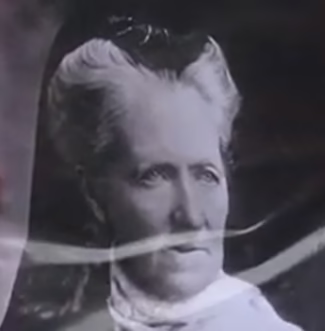
Distinctive Style: Despard was instantly recognizable. She wore a self-designed, timeless uniform. This consisted of a long, flowing black dress or robe. She wore leather sandals (or boots in winter). She completed the look with a black lace mantilla or shawl. This distinctive style symbolized her rejection of fashion and class norms. It also represented her ascetic beliefs.
The WFL's Endurance: The organization she co-founded, the WFL, proved remarkably durable. It continued to lobby for feminist causes. The WFL survived as an influential group until 1961. This was long after many other suffrage societies had dissolved.
Pioneer Status: She was a pioneer across multiple fields. She was one of the first women Poor Law Guardians. She was among the first women to run for Parliament. She was an early advocate for social welfare. Furthermore, her radical socialism pushed the boundaries of the suffrage movement.
The Unifying Dream: On the day women gained the vote in 1918, Despard expressed her enduring spirit. She said that when an impossible dream comes true, one must pursue another. She believed the true unity of humanity was the next great dream.
Despard’s life was an incredible testament to principle. She never compromised her vision for a just, equitable, and peaceful society. She transitioned from Edwardian drawing rooms to communist rallies. Charlotte Despard remains an inspiring figure for social and political reformers.
