John Torrence Tate Jr. (1925–2019) stands as one of the most towering and influential figures in the history of twentieth-century mathematics. Over a career spanning more than six decades, Tate reshaped algebraic number theory and arithmetic geometry. He did this so deeply that his name has become permanently woven into the vocabulary of modern mathematics. Terms like Tate's Thesis, the Tate Conjecture, the Tate Module, Lubin–Tate extensions, the Néron–Tate height, Tate cohomology, and the Tate–Shafarevich group are not just isolated discoveries; they are the foundational infrastructure upon which contemporary number theory is built.
In 2010, the Norwegian Academy of Science and Letters awarded Tate the Abel Prize. Often regarded as the Nobel Prize of mathematics—citing
"his vast and lasting impact on the theory of numbers."
The academy noted that
"many of the major lines of research in algebraic number theory and arithmetic geometry are only possible because of the incisive contributions and illuminating insights of John Tate."
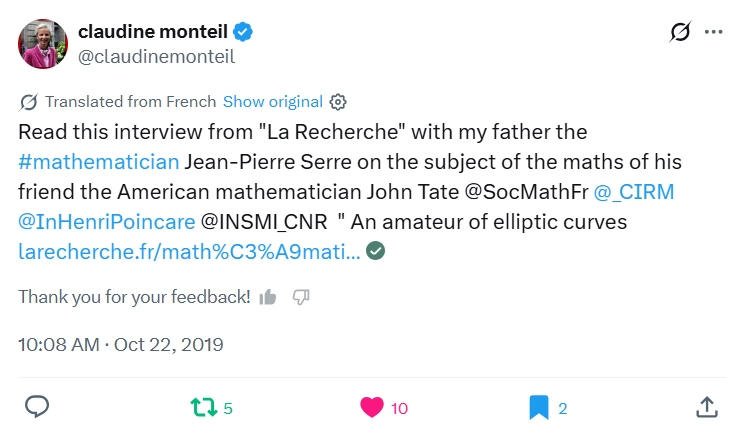
@claudinemonteil Tweet [Oct 2019]
To truly appreciate Tate’s genius, one must explore not just his biographical trajectory, but the profound substance of his ideas. His work serves as the vital, missing bridge that transformed classical nineteenth-century number theory into the sprawling, interconnected, geometric landscape of the modern era. Directly laying the groundwork for the Langlands Program.
1. Early Life, Education, and the Genesis of a Mathematician
John Tate was born on 13 March 1925, in Minneapolis, Minnesota. His father, John Torrence Tate Sr., was a highly accomplished physicist and professor at the University of Texas and later the University of Minnesota, who served as an editor for the prestigious journal Physical Review. Growing up in an environment steeped in rigorous scientific inquiry, the younger Tate displayed an early aptitude for analytical thought. Though his initial academic interests leaned toward physics rather than pure mathematics.
Tate earned his bachelor’s degree in physics from Harvard University in 1946. However, during his undergraduate years and subsequent entry into graduate school, he found himself increasingly drawn to the absolute clarity and structural beauty of abstract algebra. He transferred to Princeton University to pursue graduate studies in mathematics. A move that would alter the trajectory of modern number theory.
At Princeton, Tate became the doctoral student of Emil Artin, one of the twentieth century's greatest algebraists. Artin was a demanding yet deeply inspiring mentor known for his elegant, conceptual approach to algebraic structures. The intellectual chemistry between Artin and Tate was immediate and profound. Under Artin's guidance, Tate began looking at the deep, unresolved mysteries of global class field theory.
The study of abelian extensions of algebraic number fields. Tate completed his PhD in 1950. His doctoral dissertation, titled simply Fourier Analysis in Number Fields and Local Zeta-Functions, would instantly achieve legendary status. Known universally today as "Tate's Thesis," this single 66-page document completely revolutionized algebraic number theory and set the stage for everything that was to follow in modern arithmetic.
2. Tate's Thesis: The Blueprint for the Langlands Program
To understand the monumental impact of Tate’s 1950 thesis, one must look at the mathematical landscape of the time. For decades, mathematicians had been studying algebraic number fields (extensions of the rational numbers (Q) using two separate, cumbersome toolkits: local methods (focusing on individual prime numbers and p-adic fields) and global methods (focusing on the entire field at once).
Furthermore, nineteenth-century giants like Bernhard Riemann and later Erich Hecke had shown that the deepest secrets of prime numbers are locked inside analytic functions called L-functions (generalizations of the Riemann zeta function). Hecke had proved that these L-functions satisfy a "functional equation". A deep, symmetrical relationship connecting the behavior of the function at a point s to its behavior at 1-s. However, Hecke’s original proof was incredibly complicated, relying on highly intricate, classical multi-variable calculus and theta functions.
The Breakthrough: Harmonic Analysis on Adeles
Tate’s stroke of genius was to apply the tools of modern harmonic analysis—specifically Fourier analysis, which engineers and physicists use to break down complex signals into pure waves—to the abstract world of number theory. To do this, Tate utilized a mathematical object called the Adele ring (A). The adeles are a vast, topological ring that packages all the local information of a number field (the real numbers, complex numbers, and all p-adic completions for every prime p) into one single, unified global object.
While the concept of adeles had been introduced shortly before by Claude Chevalley, it was Tate who realized their true analytical power. By defining an appropriate measure (Haar measure) on the adeles and the group of ideles (the invertible elements of the adeles), Tate showed that one could conduct Fourier analysis directly on these abstract structures. He defined a global zeta function as a Fourier transform of a smoothly varying function on the adeles.
The Masterful Proof
Using a sophisticated version of the Poisson Summation Formula applied to the adeles, Tate proved the analytic continuation and functional equation of Hecke's L-functions in a few elegant pages. What had previously required pages of agonizingly complex, opaque calculations was suddenly revealed to be a natural, beautiful consequence of geometric symmetry and harmonic analysis.
When in the Course of human events, it becomes necessary for one people to dissolve the political bands which have connected them with another, and to assume among the powers of the earth, the separate and equal station to which the Laws of Nature and of Nature's God entitle them, a decent respect to the opinions of mankind requires that they should declare the causes which impel them to the separation.