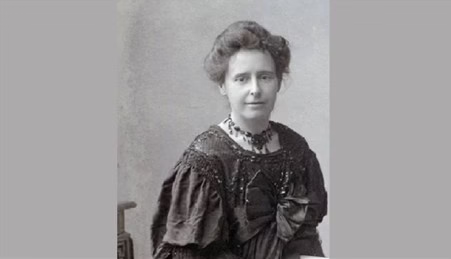
Kate Harvey (1862-1946) was a formidable English suffragist, known less for fiery rhetoric and more for the quiet, unyielding power of her personal defiance. Her life was a profound testament to the power of principled, non-violent civil disobedience, making her one of the most effective and enduring figures in the Women’s Freedom League (WFL). As a prominent member of the Women’s Tax Resistance League (WTRL), Harvey transformed a niche political tactic into a highly publicized spectacle, enduring sieges and imprisonment for her core belief:
"No taxation without representation."
Her story is not just one of political activism, but one of deep humanitarian commitment and personal courage. She was a dedicated physiotherapist, a compassionate caretaker for sick children, and—most significantly—the close companion and partner of fellow radical Charlotte Despard. Harvey’s quiet tenacity, even as she faced the world with profound deafness, made her a uniquely powerful and inspirational voice in the fight for women’s enfranchisement. Her enduring legacy is woven into the very fabric of the WFL’s history of "constitutional militancy."
Felicia Catherine Glanvill, who would become known as Kate Harvey, was born in Peckham, London, in 1862. Loss and resilience shaped her early life. Indeed, both parents died before she reached sixteen. Consequently, this forced her to navigate adulthood with a powerful sense of independence. Moreover, a significant part of her identity was forged by her profound deafness early in life. However, she managed this disability with remarkable resilience. She often relied on lip-reading and finger-spelling, rather than conventional sign language.
Financial Independence: Her marriage in 1890 to Frank Harvey, a cotton merchant, provided financial stability. His death in 1905 left her a wealthy widow with three daughters. This wealth, like that of her future partner, Charlotte Despard, became a resource for social reform, not personal luxury.
Pioneering Caretaker: Harvey demonstrated an immediate and powerful commitment to the disadvantaged. She established and funded a home for disabled and sick children in Bromley, Kent. This was a place of refuge and education, showcasing her dedication to practical charity.
Physiotherapy Profession: Beyond charitable funding, Harvey became an early practitioner of physical therapy (physiotherapy). This choice was radical; it placed her in a professional, medical field at a time when women were heavily discouraged from practicing medicine, particularly in roles involving hands-on treatment. Her work underscored her lifelong devotion to health and care.
It was this blend of personal principle and pragmatic humanitarianism that led her inevitably to the suffrage movement. She believed that political power was essential to protect vulnerable populations.
Around 1907, Kate Harvey joined the militant wing of the suffrage movement, finding her political home in the Women’s Freedom League (WFL). This organization was founded by women who had split from the WSPU, insisting on both direct action and democratic governance. Harvey was a perfect fit for the WFL’s ethos of "constitutional militancy"—a belief that non-violent civil disobedience was the most moral and effective path to the vote.
Harvey quickly became a core organiser for the WFL’s Bromley branch. Her organizational skills were vital to the League, which relied on local chapters for operational strength and funding.
The Coronation Procession (1911): Her dedication was highlighted when she helped organize the massive Women’s Coronation Procession for George V. This demonstration brought thousands of suffragists into London, showcasing the widespread support for the cause under the WFL’s peaceful banner.
The Census Boycott (1911): Harvey participated in one of the WFL’s most successful acts of non-cooperation: the 1911 Census Boycott. Refusing to complete her census forms, she argued that if she was not a political citizen, the state had no right to count her. The enumerator at her home famously noted that the house was "filled with suffragettes who refuse information."
Kate Harvey’s friendship and companionship with WFL President Charlotte Despard became one of the most celebrated and enduring political partnerships of the suffrage era. Their bond was deep, affectionate, and mutually empowering.
Shared Ideals: They were both wealthy widows who rejected traditional femininity, embraced socialism, and championed pacifism. They found common ground in their humanitarian work, particularly their mutual interest in Theosophy and progressive spirituality.
Partnership and Co-Residence: Their relationship transcended mere political alliance. In 1916, they formalized their commitment by purchasing the estate at Upper Hartfield near Ashdown Forest. This home became the base for their later philanthropic and anti-war activities. This co-residence and shared life provided emotional and financial stability, underpinning their decades of radical politics.
Kate Harvey’s name is synonymous with the Women’s Tax Resistance League (WTRL). This was a specialised auxiliary of the WFL dedicated to the slogan
"No Taxation Without Representation."
For Harvey, tax resistance was the purest form of non-violent protest.
Harvey’s initial foray into resistance began over a trivial amount of money: the stamp duty for her gardener’s license in 1911. Her refusal was not about the fee, but about the principle.
The Long Standoff: Her refusal sparked an epic, public confrontation with the state that spanned two years. When bailiffs came to her Bromley home to seize property in lieu of the unpaid tax, Harvey took dramatic, defiant action.
The Barricades: She and her suffragist allies barricaded the house using heavy furniture and boards. The home became a literal fortress of protest. This initial standoff lasted an extraordinary eight months before authorities managed to gain entry.
Seizure and Publicity: Once inside, bailiffs seized goods, which were then set to be auctioned off. These forced auctions became highly publicized spectacles where WTRL supporters would gather. The auctions frequently failed as supporters successfully used political tactics to ensure no bids were made on the property. This was a humiliation for the state and a powerful victory for the suffragists.
Harvey escalated her defiance in 1913 by refusing to pay the required National Insurance stamp tax for her household servant. The servant was deliberately named Asquith—the same surname as the sitting Prime Minister, Henry Herbert Asquith. This direct poke at the government gained maximum media attention.
The Battering Ram: Having learned from the previous siege, Harvey fortified her home even more successfully. When bailiffs returned, they were forced to use a battering ram to break down her barricades and gain entry.
Arrest and Sentence: Harvey was arrested and brought before the Bromley Police Court. She was convicted for failing to pay fines related to the Insurance Act. She declared dramatically, "I would rather die first" than compromise her political principles by paying the fine.
Holloway Prison: Kate Harvey was sentenced to two months in Holloway Prison. This distinguished her as the first person imprisoned under the Insurance Act for tax resistance. Her sentence was disproportionately harsh, highlighting the government's frustration with her unwavering non-compliance.
Solidarity and Release: Her imprisonment galvanized the WFL and WTRL. The WFL and WTRL immediately organized massive protests, including forceful rallies in Trafalgar Square. Consequently, the sustained, intense public pressure mounted against the government. Furthermore, concerns rapidly grew over her health, which her deafness severely exacerbated. Therefore, authorities released her after she served only one month. Following her release, the WFL awarded her the prestigious Holloway Prison badge medal, explicitly recognizing her extraordinary fortitude and sacrifice.
The outbreak of World War I in 1914 saw Kate Harvey and Charlotte Despard stand apart from the mainstream women's suffrage movement. While the Pankhursts' WSPU suspended campaigning to support the war effort, Harvey and Despard remained staunch pacifists.
Anti-War Stance: Harvey actively opposed the conflict, a move that required significant moral courage and political sacrifice. She supported Despard’s work in the Women’s Peace Crusade, denouncing the violence and militarism that had engulfed Europe.
Wartime Relief: Her deep humanitarian instinct immediately took precedence. Harvey converted her own home in Bromley into a hospital and refuge. This institution primarily focused on providing care and shelter for refugee women and children displaced by the horrific conflict in mainland Europe.
The Brackenhill School: The estate she shared with Despard in Hartfield was transformed into the Brackenhill Open Air Home School. This institution was a radical expression of their shared progressive philosophy:
Holistic Health: The children followed a strict vegetarian diet.
Progressive Education: The school employed the Montessori method and principles of self-government, treating children with the respect and autonomy denied to adults by the government.
Open-Air Living: Children slept in covered, shuttered shelters outdoors, reflecting a belief in the therapeutic benefits of fresh air and nature.
Kate Harvey synthesized her spiritual beliefs, deep compassion, and political action; this union defined her entire life. She continued her reform work, rooted in the principles of health and equity, long after women achieved the vote in 1918. Her long-standing partnership with Charlotte Despard continued to be a source of strength until Despard's death in 1939.
Harvey passed away at her home in Hartfield in 1946. Her legacy is not merely one of tax refusal; it is one of translating a profound moral principle into tangible political and personal action. The story of Kate Harvey demonstrates that true militancy often requires not brute force, but the quiet, dignified refusal to cooperate with injustice—a method that proved profoundly effective in shaking the foundations of the British establishment and paving the way for female equality.
