Lucretia Coffin Mott (1793–1880) stands as one of the most foundational and formidable figures in 19th-century American reform. A Quaker minister by vocation and a relentless social justice activist by calling, Mott’s life testified to the power of moral conviction translated into action. She fought slavery with fierce determination and co-founded the nascent women’s rights movement. Her partnership with Elizabeth Cady Stanton at the Seneca Falls Convention formally began the organized struggle for equality. Mott's unwavering commitment to the "Inward Light" of Quakerism provided the moral compass she used to challenge institutionalized oppression and champion human dignity.
Lucretia Coffin was born on January 3, 1793, on Nantucket Island, Massachusetts. Her lineage traced back to the island's original settlers. Her upbringing was deeply steeped in seafaring culture and the liberal values of the Society of Friends, or Quakers.
Nantucket was a unique incubator for a future reformer. The whaling industry often kept men away for long periods. This led to a matriarchal social structure where women managed business affairs and held considerable influence, especially in the Quaker meeting. Consequently, this environment instilled in young Lucretia an early appreciation for female competence and leadership. This experience later underpinned her advocacy for women’s public roles.
Her education began at a local co-educational school, but at the age of thirteen, she was sent to the Nine Partners Boarding School in Dutchess County, New York, a Quaker institution. Two defining events occurred here: she met her future husband, James Mott, and she first encountered institutionalized inequality. While studying and later working as an assistant teacher, she noted that female instructors were paid less than half the wages of their male counterparts. This early, direct confrontation with wage discrimination sparked a lifelong commitment to economic and gender equality.
In 1811, she married James Mott, a fellow teacher and merchant. Their partnership was extraordinary. It was marked by mutual respect, shared moral principles, and complete unity in their political and social commitments. James Mott was a steadfast supporter of his wife’s public ministry and activism, a radical stance for a man of that era. They settled in Philadelphia, a hub of Quakerism and abolitionist activity, which cemented the course of Lucretia’s career.
By 1821, Lucretia Mott became an acknowledged minister of the Society of Friends. The Quaker belief in the direct relationship between the individual and God, the rejection of a paid clergy, and the acceptance of women’s public ministry—speaking in meetings—provided her with a crucial platform and a theological justification for her public activism.
The Motts belonged to the Hicksite branch of Quakerism, a group known for its liberal theology and strong commitment to social justice. This branch fully embraced the cause of immediate abolition, rejecting the gradualist approaches favored by others.
Lucretia Mott’s commitment to abolition was absolute. She and James took a firm stand against the use of slave-produced goods, boycotting cotton and sugar. Furthermore, she often used her sermons to condemn the moral evil of slavery.
Her activism intensified in the 1830s. When men founded the American Anti-Slavery Society (AASS), the Motts became deeply involved. However, Mott quickly realized that the fight for racial equality was inextricably linked to the fight for gender equality. She and other female activists faced systematic exclusion from leadership roles and even from speaking at abolitionist conventions.
In 1833, Lucretia Mott co-founded the Philadelphia Female Anti-Slavery Society (PFASS) in response to this discrimination. This organization was revolutionary. It not only organized petitions, boycotts, and fundraising efforts to support abolition, but also provided a vital training ground for women in public speaking, organizing, and political action. The PFASS often faced violent anti-abolitionist mobs, yet Mott and her colleagues repeatedly demonstrated incredible moral and physical courage, often walking fearlessly through angry crowds to attend their meetings.
The pivotal moment that launched Mott's dual career in abolition and women's rights was the World Anti-Slavery Convention in London in 1840. Mott, along with several other female delegates from American abolitionist societies, travelled to England, expecting to participate fully.
Upon arrival, however, the organizers refused them seating and voting rights. After a contentious debate, they relegated the women to a curtained-off gallery, forcing them to listen in silence. Crucially, it was in this segregated gallery that Lucretia Mott met a young American delegate’s wife, Elizabeth Cady Stanton.
Stanton, who attended the conference with her abolitionist husband, was outraged by the blatant sexism. She was captivated by the eloquent and intellectually formidable Mott, already a famous preacher. As they walked the streets of London, they discussed the profound contradiction of fighting for the rights of the enslaved while being denied their own. Therefore, they agreed that upon returning to the United States, they must hold a convention specifically dedicated to women's rights. This promise, born of exclusion in London, laid the groundwork for the most significant event in the early history of American feminism.
The London incident proved to be a powerful catalyst. After eight years of continued advocacy and planning, Mott and Stanton fulfilled their promise.
In July 1848, Lucretia Mott, Elizabeth Cady Stanton, and three other Quaker women (Martha C. Wright, Jane Hunt, and Mary Ann M’Clintock) organized the First Women’s Rights Convention in Seneca Falls, New York.
Mott, the senior and most respected activist present, provided the moral gravity and intellectual authority for the event. She opened the proceedings and served as a steadying influence, particularly during the debates over Stanton’s most controversial resolution: the demand for women’s suffrage. Many, including Mott's own husband James, believed the demand for the vote was too radical and would undermine the convention’s credibility. However, Mott supported Stanton's right to present the demand, and the suffrage resolution ultimately passed by a narrow margin.
The convention adopted the Declaration of Sentiments, a document primarily drafted by Stanton and modelled after the Declaration of Independence. It listed the injustices against women and demanded equal rights in property, education, divorce, employment, and, crucially, the right to vote. The Seneca Falls Convention marked the formal beginning of the women’s suffrage movement in the United States, and Lucretia Mott was its most prominent elder statesman.
After the Civil War and the end of chattel slavery, reform movements shifted focus to securing constitutional rights for the newly freed black population. This period presented a profound challenge to the alliance between the abolitionist and women’s rights movements.
Mott and Stanton, along with other women’s rights advocates, formed the American Equal Rights Association (AERA) in 1866. They advocated for universal suffrage—the right to vote for all citizens, regardless of race or sex.
However, the political climate favoured securing rights for black men first. The proposed Fifteenth Amendment would grant suffrage specifically to black men while explicitly excluding women. This issue caused a painful split within the AERA.
Mott, ever the peacemaker and universalist, tried to maintain unity, arguing that all rights should be secured simultaneously. Nevertheless, she was heartbroken when the movement fractured. Stanton and Susan B Anthony opposed the Amendment vehemently, arguing it was a betrayal of women’s rights. Others, like Frederick Douglass, supported the Amendment as a necessary, immediate step for racial justice.
When the split became official in 1869, Mott briefly served as the first president of the umbrella group, the American Woman Suffrage Association (AWSA). This organization focused on state-by-state campaigns, trying to find common ground. However, her true spiritual home remained with the radical, non-sectarian, and universalist view of human rights she had always espoused.
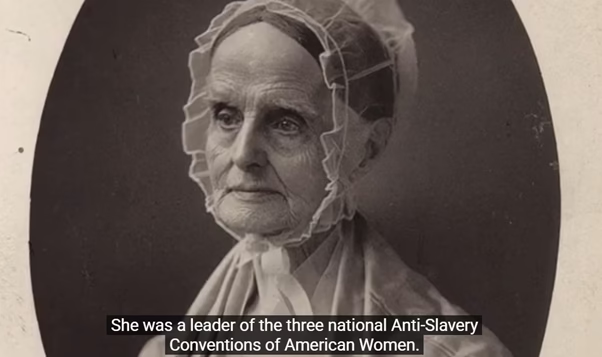
Lucretia Mott’s activism was never confined to just two causes. Her philosophy was one of "radical non-resistance," meaning she applied her moral framework to every institution she believed perpetuated injustice.
Mott was a committed pacifist, deeply influenced by her Quaker faith. She opposed the Mexican-American War and the Civil War, though she supported the Union cause morally. She was a founding member of the Universal Peace Union in 1866, advocating for the resolution of international disputes through arbitration rather than war.
Mott was an advocate for educational equality. She helped found the Philadelphia School of Design for Women. Furthermore, along with James, she was instrumental in establishing Swarthmore College in 1864, a Quaker co-educational institution. Her belief that women were intellectually equal to men informed her every effort to open doors in education and employment.
As a Hicksite Quaker minister, Mott remained a staunch advocate for religious freedom and tolerance. She embraced a broad definition of spirituality and often preached to mixed audiences, becoming one of the most famous female religious orators of her time. In her sermons, she often emphasized that true Christianity required active, ethical engagement in social reform, famously stating, "My life is one long sermon."
Lucretia Mott spent her final years at Roadside, her home near Philadelphia. This location remained a central meeting place for reformers of all stripes—abolitionists, suffragists, temperance advocates, and peace activists. She continued to write, speak, and serve as an ethical touchstone for the movements she helped birth.
She died on November 11, 1880, at the age of 87. Her passing was mourned across the nation. She was rightly celebrated as a pioneering figure who bridged the greatest reform movements of the 19th century.
Her enduring legacy can be summarized in three ways:
Lucretia Mott remains a towering figure—a woman whose gentle demeanour masked a steely resolve, and whose unwavering belief in universal human rights fundamentally altered the course of American history.
