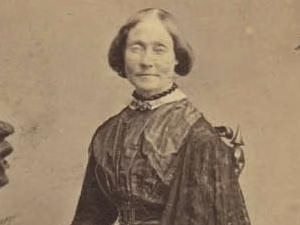
Mary Estlin (1820 - 1902) was a Bristolian abolitionist and campaigner for women’s rights. She was both a staunch radical and, in many ways, a typical ‘society lady’. Although the impact that her privileged social standing had on her outlook cannot be ignored, her lifelong pursuit of justice speaks for itself; she sought, at every turn, to make the world a better place.
Mary Ann Estlin was born 31st July 1820, into a wealthy and reputable Bristolian family. Her father, John Bishop Estlin was a leading ophthalmologist, known throughout the west of England. Himself the beneficiary of a privileged upbringing, John Estlin was raised in a house where Samuel Taylor Coleridge, Robert Southey and Joseph Priestley were frequent guests. After his studies in Bristol, London and Edinburgh, John settled down to establish a dispensary of ophthalmic medicine in Bristol, earning himself success and social standing. Throughout his life, he continued to fraternise with the gentry of western England.
In 1817, John Estlin married Margaret Bagehot – but Margaret died only four years later, leaving behind the couple’s baby daughter, Mary. Mary never married; she lived with her father for the duration of his life, and shared many of his interests, including his devotion to Unitarianism.
In 1832, John visited the island of St Vincent, in the hopes of improving his poor health. He brought Mary with him, and it was here that she witnessed the colonial slave trade first-hand. Both father and daughter remained committed abolitionists for the duration of their lives.
For Mary, her close relationship with her father allowed her to pursue radical ends without the conflict of abandoning convention. It was thought to be essential that nineteenth century women have a vocation; for married women, this was their homes and families. However, for single women like Mary, this posed a problem; they were expected to have a calling, but not one that brought them into the public sphere, which was reserved exclusively for men.
Still, Mary was able to work alongside her father in abolitionist activism, both as a dedicated campaigner and as a dutiful daughter. Through her correspondence with leading abolitionists, she was engaging in important conversations within the movement, while fulfilling the role of the unmarried daughter in maintaining the family’s social connections.
In truth, though, her heart lay in activism, and the tension between her desire to work and her domestic duties was exacerbated when her father fell ill. Keen to be editing the Estlin’s journal, ‘The Antislavery Advocate’, Mary wrote at the time,
"My father's enforced inactivity compels me to spend a great deal of time in helping him to do nothing".
It is interesting that, despite her frustration and the family’s considerable means, Mary chose not to hire a nurse for her father, but place the whole burden of his care upon herself. John died in 1855, when Mary was thirty-four.
Mary struggled to return to reform work after her father’s death. She spent months staying with Edinburgh abolitionists Jane and Eliza Wigham, in order to rebuild her strength and confidence. Previously, Mary had largely focussed her activism in Bristol, leading the Bristol and Clifton Ladies Anti-Slavery Society.
However, upon returning to work her reach began to extend, and she became involved in Clementia Taylor’s push for a ladies’ emancipation society. Taylor was a prominent campaigner for women’s suffrage and the abolition of slavery; she had a reputation for being both a respectable society woman, and a deeply charitable person. Louisa May Alcott described Taylor as
“a model Englishwoman – simple, sincere and accomplished, [with a house that is] open to all, friend and stranger, black and white, rich and poor.”
Her parties were noted for their unique character, with fellow suffragist Elizabeth Malleson writing that they combined
“all kinds of literary people – refugees from several countries – artists and humble lovers of social enjoyment…with supporters of ‘causes’ of all kinds”.
After reading Harriet Beecher Stowe’s open letter in the Atlantic Monthly, calling the women of England to support the North in the American Civil War, Taylor felt compelled to act. Her application to join the London Anti-Slavery Society was turned down due to her gender, so she – alongside Mary Estlin, Eliza Wigham and others – founded the Ladies’ London Emancipation Society in 1863. The society disseminated anti-slavery material to the public, emphasising the moral case for the Union cause in the American Civil War. In total, the society amassed over two-hundred members, many of them new to the anti-slavery cause.
Mary continued in her activism throughout her life. In 1867, she was involved in establishing the Bristol Women’s Suffrage Society. She was also a long-standing member of the executive committee of the Ladies’ National Association, which co-ordinated the campaign to repeal the Contagious Diseases Act. The Act, passed by parliament in 1864, allowed police officers to arrest women they suspected of being sex workers in ports and army towns, to have them checked for venereal disease; if the women were suffering from disease, they were forcibly hospitalised until cured. This barbaric law was eventually repealed in 1886, after much tireless feminist campaigning.
Mary Estlin died in 1902 in her home in Bristol, aged eighty-two.
It would be impossible to give a full account of Mary’s life without mentioning her strange connection to Parker Pillsbury. Pillsbury was an American minister, abolitionist and advocate for women’s rights. In 1854, Pillsbury came to Britain to compare the political differences between British and American abolitionists. During this period, he stayed with the Estlins.
Pillsbury arrived in Britain just as the British and Foreign Anti-Slavery Society was changing leadership; the new leader, Louis Chamerovzow, invited Pillsbury to speak at the organisation’s anniversary – a move that seemed to signal a desire to work with the more radical abolitionists in the organisation. Unfortunately, a misunderstanding led to Pillsbury attending the event, but not speaking, leaving both men suspicious of one another. Pillsbury then escalated the situation by writing a scathing review of the anniversary, calling the event
“a farce, a mere make-believe”.
Relations continued to sour; the men exchanged a series of increasingly tense letters. Chamerovzow began with a friendly letter, querying some numbers Pillsbury referenced in a speech. This made Pillsbury furious; he saw the pretence at friendship
“a most impudent, insulting, unbearable piece of…hypocrisy”.
He wrote an emotional reply, but first sent his letter to the Estlins for them to edit. They watered down the letter somewhat, but the final draft still called Chamerovzow
“weak if not wicked”.
Chamerovzow, who knew nothing of the Estlins’ involvement, sent John and Mary his own sixteen-page response to Pillsbury, in which he criticised the American’s “ungentlemanly” conduct. At this point, the pair stopped writing directly to one another, instead focussing on defending themselves to the Estlins. Neither man was at any point made aware of the Estlins’ double role in the dispute. In a final twist of events, the Estlins then decided to make the full correspondence public by sending copies of the letters to key figures in the anti-slavery movement.
While this whole debacle might seem rather trivial, it provides insight into the ways that the Estlins class status impacted their activism. In ‘Parker Pillsbury: Radical Abolitionist, Male Feminist’, historian Stacey M. Robertson notes that Pillsbury and Chamerovzow
“appealed to the Estlins – because of their social standing and power in the movement – for validation”.
The Estlins’ somewhat underhanded behaviour particularly disadvantaged Pillsbury, who was subjected to classist criticism as a result of the letters’ public dissemination. Indeed, Mary herself described Pillsbury’s style of thought as
“so peculiar and unlike our own, as to be unintelligible”.
All in all, Mary Estlin’s life presents within it the contradictions of many of the suffragists of the era: she was both a fierce activist, and a woman struggling with the conflict between her own ambitions and her social role. She was a campaigner for social justice, yet couldn’t quite escape her own class prejudices. She was a hero, and also as flawed, and as human, as the rest of us.
© Ros Knowles
Unearthing the Suffragette Spirit Project
Oxford Dictionary of National Biography; Estlin, Mary Anne; https://doi.org/10.1093/ref:odnb/50721
Stacey M. Robertson; Parker Pillsbury: Radical Abolitionist, Male Feminist; ‘An American Abolitionist Abroad’, pp. 91-114.
English Heritage; Aubrey House; https://www.english-heritage.org.uk/visit/blue-plaques/aubrey-house/
Royal College of Surgeons of England; Estlin, John Bishop; https://livesonline.rcseng.ac.uk/client/en_GB/lives/search/detailnonmodal/ent:$002f$002fSD_ASSET$002f0$002fSD_ASSET:372680/one
Lee Chambers-Schiller; ‘The Single Woman Reformer: Conflicts between Family and Vocation, 1830-1860’; in Frontiers: A Journal of Women Studies; Vol. 3, No. 3 (Autumn, 1978); https://www.jstor.org/stable/3346328
