
How Bernoulli Numbers, Fibonacci, Ada Lovelace, and Van Gogh Intersect
When exploring the geometry of order and chaos, mathematics reveals a web of hidden connections. Integers live in arithmetic, curves live in geometry, and physical systems live in analysis. However, two famous numerical sequences appear completely different on paper. These are the Fibonacci sequence and the Bernoulli numbers. One governs predictable growth, while the other governs complex analysis.
Yet, following these constructs leads to an incredible journey. Specifically, they connect the birth of computer science in the mind of Ada Lovelace to the swirling skies painted by Vincent van Gogh, to Nikola Tesla.
1. Growth vs. Oscillation: The Geometry of Order and Chaos in Numbers
To understand this convergence, we must first compare their core machinery.
The Fibonacci Sequence: The Architecture of Organic Growth
The Fibonacci sequence (Fn) uses a simple recursive rule. Each term is the sum of the two preceding ones:
-
F(0) = 0
-
F(1) = 1
-
F(n) = F(n-1) + F(n-2) for n >= 2
This rule generates the sequence 0, 1, 1, 2, 3, 5, 8, 13, 21, 34, 55, and so on. Consequently, its growth rate rapidly approaches the Golden Ratio (Phi, roughly 1.618). Because of this property, Fibonacci numbers appear frequently in biological structures. For instance, we see them in sunflower seed patterns, pinecone spirals, and nautilus shells. Thus, it represents nature's solution for efficient structural growth.
The Bernoulli Numbers: The Hidden Mechanics of Sums
In contrast, Bernoulli numbers (Bn) do not come from pinecones. Instead, they arise from calculus and power sums. Mathematicians discovered them while solving a fundamental question: Is there an algebraic formula for the sum of p-th powers of the first n integers?
-
Sum(k^p) = 1^p + 2^p + 3^p + ... + n^p
The coefficients of these power formulas are the Bernoulli numbers. Unlike the positive integers of the Fibonacci sequence, Bernoulli numbers are rational fractions. Moreover, all odd terms above B1 equal zero:
-
B(0) = 1
-
B(1) = -1/2
-
B(2) = 1/6
-
B(3) = 0
-
B(4) = -1/30
-
B(5) = 0
-
B(6) = 1/42
-
B(7) = 0
-
B(8) = -1/30
Furthermore, Bernoulli numbers explode in magnitude at higher even indices. Their values are driven by factorials in their generating function:
-
t / (e^t - 1) = Sum [ B(n) * (t^n / n!) ]
| Feature | Fibonacci Sequence (Fn) | Bernoulli Numbers (Bn) |
| Mathematical Nature | Pure Integers | Rational Numbers (Fractions) |
| Governing Function | Rational function: x / (1 - x - x^2) | Exponential function: t / (e^t - 1) |
| Primary Domain | Combinatorics, structural growth | Number theory, power sums |
| Behavior | Increasing exponential growth | Oscillating sign, zero for odd n >= 3 |
2. Order and Chaos Bridges: Where Bernoulli Meets Fibonacci
Despite their structural differences, number theorists found deep connections between these two sequences.
Pascal’s Triangle as the Common Ancestor
Both sequences stem from Pascal’s Triangle:
-
Summing the shallow diagonals of Pascal’s triangle generates the Fibonacci sequence directly.
-
Manipulating the rows of Pascal's triangle yields the matrix operations for Bernoulli numbers.
Modular Congruences and Kelisky’s Formula
The deepest bridge was formalized by Richard Kelisky in 1957. Kelisky proved that Bernoulli numbers can be written directly through sums of Fibonacci numbers and binomial coefficients.
Additionally, in modular arithmetic, Bernoulli numbers follow the famous Kummer congruences. These mirror the periodic behavior of Fibonacci numbers modulo m, known as Pisano periods. Therefore, both sequences help explain how step-by-step arithmetic transitions into smooth functions.
3. The Ada Lovelace Connection: Algorithmic Geometry of Order and Chaos
The bridge between pure mathematics and modern computing relied heavily on Bernoulli numbers. Ada Lovelace was the first to realize this computing potential.
In 1842, Luigi Menabrea published a paper on Charles Babbage’s proposed mechanical computer, the Analytical Engine. Lovelace translated the paper into English. In addition, she added extensive commentary known as the Notes.
Her commentary was three times longer than the original paper. The highlight of these writings was Note G.
                       NOTE G: ALGORITHM FOR BERNOULLI NUMBERS

  +-------------------+       +-------------------+       +-------------------+
  |  Variable Cards   | ----> | Operation Cards   | ----> | Number Cards      |
  |  (Set up B_n ops) |       | (Loops & Branches)|       | (Store fractions) |
  +-------------------+       +-------------------+       +-------------------+
                                        |
                                        v
                          Calculates B_1, B_3, B_5... B_n
                          First Non-Trivial Computer Code
In Note G, Lovelace chose Bernoulli numbers to demonstrate the machine's power. But why choose Bernoulli numbers over Fibonacci?
-
Complexity: Fibonacci numbers are easy to compute recursively (A + B = C). They need minimal memory tracking.
-
Fractional Loops: Bernoulli numbers require fractions, nested equations, and conditional loops.
Lovelace wrote a step-by-step trace showing how the machine could compute Bn automatically. Consequently, she wrote the world's first complex computer algorithm.
Moreover, Lovelace made a profound philosophical leap. Babbage saw his machine as a simple calculator. In contrast, Lovelace realized that numbers could represent abstract concepts like music or shapes. Thus, she envisioned modern software to master the geometry of order and chaos.

4. The Van Gogh Connection: Visualizing the Geometry of Order and Chaos
While Lovelace used Bernoulli numbers for computation, Vincent van Gogh intuitively painted Bernoulli's fluid dynamics.
In June 1889, Van Gogh painted The Starry Night at Saint-Rémy-de-Provence. The painting features expressive, swirling brushstrokes across a glowing night sky.
Fluid Mechanics and Kolmogorov Turbulence
In fluid dynamics, chaotic fluid motion is governed by the Navier-Stokes equations. Modeling turbulence remains a huge challenge in physics. However, in 1941, Andrey Kolmogorov proposed a statistical theory for turbulent energy cascades scaling as K^(-5/3).
In 2008, physicists analyzed luminance fluctuations in Van Gogh's paintings during his emotional crises.
Their discovery was astounding. Van Gogh’s painted swirls match the exact mathematical signature of turbulent fluid flow.
The Invisible Bridge: Daniel Bernoulli's Hydrodynamics
So, how does this link back to Bernoulli?
The foundation of fluid turbulence comes from Daniel Bernoulli, nephew of Jakob Bernoulli. In 1738, Daniel published Hydrodynamica and introduced Bernoulli's Principle:
-
P + (1/2) * rho * v^2 + rho * g * h = constant
Where:
-
P = Static pressure
-
rho = Fluid density
-
v = Flow velocity
-
g = Gravity acceleration
-
h = Elevation height
This principle states that higher fluid speed causes lower static pressure. Therefore, it serves as the core equation of fluid dynamics. The shift from Daniel Bernoulli's smooth equations to Kolmogorov's chaos shows a clear path through the geometry of order and chaos.
During moments of anguish, Van Gogh intuitively rendered Bernoulli turbulence on canvas. Surprisingly, he did this decades before physicists formalized the laws of turbulent fluid motion.
5. Synthesis: Mastering The Geometry of Order and Chaos
When viewing these elements together, a clear pattern connects math, computer science, physics, and art:
                          THE SPECTRUM OF PATTERN

   ORGANIC ORDER          ALGORITHMIC LOGIC             PHYSICAL CHAOS
  [Fibonacci / Phi] ----> [Bernoulli Numbers] ------> [Bernoulli Turbulence]
         |                       |                            |
   Nature's Form          Lovelace's Note G            Van Gogh's Sky
(Pinecones & Shells)   (First Computer Program)   (Kolmogorov Luminance)
-
Fibonacci represents Organic Order: It is the deterministic geometry of natural growth.
-
Bernoulli Numbers represent Algorithmic Complexity: They powered the discrete logic that led Lovelace to invent software.
-
Bernoulli Mechanics & Van Gogh represent Fluid Chaos: Through fluid mechanics, smooth mathematical equations transition into atmospheric turbulence.
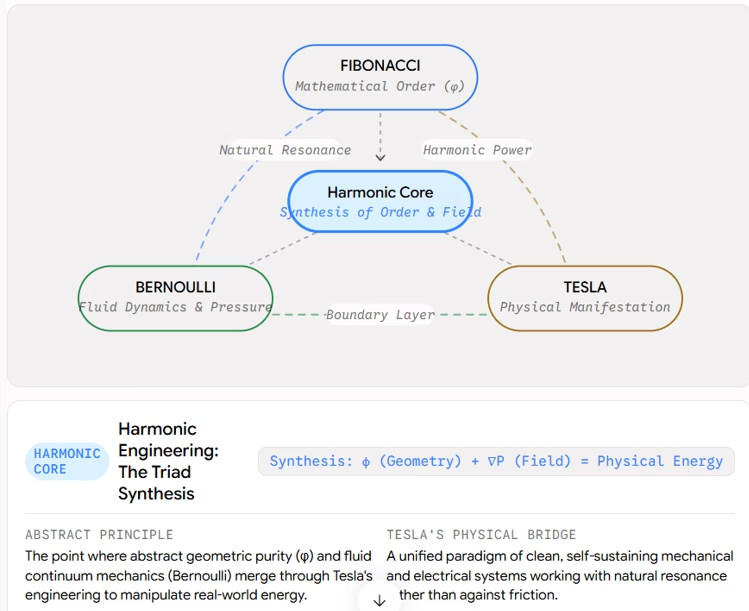
Ultimately, Fibonacci and Bernoulli numbers are closely linked. Fibonacci shows how simple rules create order. Meanwhile, Bernoulli numbers prove how the geometry of order and chaos unites human art, algorithms, and physical reality—Nikola Tesla turned that unseen geometry into the electrical backbone of the modern world.
1. Fibonacci & Tesla: Harmonic Resonance and Simple Rules
-
Fibonacci’s Principle: Complex, self-organizing systems emerge from simple additive rules (1, 1, 2, 3, 5, 8...).
-
Tesla’s Realization: Tesla believed the universe operated on fundamental mathematical frequencies and ratios—famously stating that if you knew the magnificence of 3, 6, and 9, you would have the key to the universe.
-
The Connection: Just as the Fibonacci sequence governs logarithmic spirals in nature, Tesla used spatial geometry and fractional winding patterns in his Tesla coils and transmitting inductors to achieve maximum electrical resonance with minimal energy loss.
2. Bernoulli & Tesla: Field Geometry and Fluid Dynamics
-
Bernoulli’s Principle: Bernoulli numbers sit at the center of calculus, fluid dynamics, and thermodynamics, mapping how continuous energy flows between order and turbulent chaos.
-
Tesla’s Realization: Tesla did not view electricity merely as moving particles in a wire; he treated electromagnetic fields as fluid, continuous ether dynamics.
-
The Connection: Tesla directly applied fluid flow dynamics to electromagnetism. His Tesla Turbine (a bladeless turbine operating entirely on boundary layer fluid resistance) and his alternating current (AC) rotating magnetic fields are physical embodiments of Bernoulli's continuous fluid equations applied to kinetic and electrical power.
3. Physical Reality: Bridging Abstract Math to Practical Engineering
-
Human Art & Algorithms: Fibonacci and Bernoulli describe aesthetics, nature, and pure computation on paper.
-
Tesla’s Physical Reality: Tesla took those abstract mathematical relationships—wave harmonic series, field gradients, and fluid dynamics—and forged them into physical hardware: the induction motor, wireless power transmission, radio, and the AC power grid.
Further reading: Importance of Education