
High in the sun-drenched hills of Lebanon’s Bekaa Valley, perched between the historic towns of Deir El Ahmar and Beshouat, lies an architectural and spiritual marvel unlike anything else on Earth.

Known locally as Rosaire du Liban (Rosary of Lebanon), this massive sanctuary transforms one of the Catholic Church’s most beloved devotional objects into a physical landscape. Rather than holding small wooden or glass beads in the palm of your hand, pilgrims here literally walk through 59 hollow concrete "beads". Each built as an individual chapel—stretching across a path roughly 600 meters (nearly 2,000 feet) long.
It is officially recognized as the largest walk-through rosary in the world. It is large enough to be easily identified on satellite imagery. Beyond its record-breaking scale, the site stands as a testament to resilience, community faith, and deep Marian devotion in the heart of the Middle East.
The Origin: A Vision Born from Trial
The story of the Rosary of Lebanon (Rosaire du Liban) reads almost like a modern parable. Its origins trace back to 2006, when a young Lebanese pilgrim traveled to Medjugorje, a famed Marian pilgrimage site in Bosnia and Herzegovina.
During his journey, the young man was unexpectedly detained due to an identity error. Fearing his situation, he prayed fervently to the Blessed Virgin Mary. Promising that if he were safely released, he would construct a unique sanctuary dedicated to her in his homeland. Upon his release, he returned to Lebanon determined to fulfill that vow.
He approached the Lebanese Maronite Order—a centuries-old monastic order deeply rooted in the region—to pitch an audacious idea: create a giant, physical rosary that would bridge the Christian villages of Deir El Ahmar and Beshouat across the rugged hillsides.
| Key Project Milestones | Event Details |
| 2006 | The initial vow in Medjugorje inspires the project. |
| 2008 | Construction officially breaks ground on Maronite Order land. |
| Major Milestones | Structural completion of all 59 concrete bead-chapels. |
| Ongoing Expansion | Construction of the Resurrection Cross, auditorium, and monastery complex. |
A Tradition of Anonymity: In keeping with early monastic traditions, the individual creators, designers, and major private donors behind the sanctuary have chosen to remain strictly anonymous. They insist that the project should serve solely as an instrument of prayer rather than a monument to human achievement.
Architectural Scale and Anatomy of the Site
To grasp the magnitude of the Rosary of Lebanon, one must look at the physical dimensions required to translate standard prayer beads into full-scale architecture.
  [ Start: Entrance Chapel ]
              │
              ▼
   ┌──────────────────────┐
   │  53 "Hail Mary"      │ ◄── Each bead: 5m x 3.5m walk-through chapel
   │  Concrete Chapels    │     (Dedicated to life stories of Christian saints)
   └──────────┬───────────┘
              │
              ▼
   ┌──────────────────────┐
   │  6 "Our Father"      │ ◄── Built as active Reconciliation Chapels
   │  Large Chapels       │     (Confessionals for pilgrims)
   └──────────┬───────────┘
              │
              ▼
   [ Destination: Cross of the Resurrection & Adoration Chapel ]
1. The 59 Concrete Beads
Each of the 59 beads along the 600-meter track is an arched concrete shrine measuring approximately 5 meters (16 feet) long by 3.5 meters (11 feet) wide.
-
The 53 "Hail Mary" Beads: Designed as walk-through stations. Inside, pilgrims encounter artwork, mosaics, and educational panels. Includes detailing Gospel scenes, the mysteries of the Rosary, and the lives of various saints.
-
The 6 "Our Father" Beads: Built on a larger scale to function as active confessionals. Priests sit within these structures during major pilgrimages, offering the Sacrament of Reconciliation to passing travelers.
2. The Cross of the Resurrection
The entire route is laid out linearly along the hillside, guiding the pilgrim continuously upward toward its apex: the giant Cross of the Resurrection. Beneath this terminal monument sits a dedicated chapel for Eucharistic Adoration, alongside a large open-air amphitheater designed to accommodate thousands of worshipers for evening Masses.
3. Illumination visible from the Sky
The beads have been wired with an exterior lighting system. At night, when switched on, the entire 600-meter chain glows across the dark Bekaa landscape. The design allows the shape of the rosary to remain distinct from surrounding roads and villages. Especially when viewed from airplane altitudes or satellite passes.
The Deir El Ahmar Region: Context and Cultural Impact
The location of this giant structure holds immense historical and cultural significance. Deir El Ahmar sits at the foot of the Mount Lebanon range on the western edge of the Bekaa Valley, just 30 kilometers from the Syrian border.
  ┌──────────────────────────────────────────────────────────┐
  │                 BEKAA VALLEY GEOGRAPHY                    │
  ├──────────────────────────────────────────────────────────┤
  │                                                          │
  │   [ Mount Lebanon Range ]                                │
  │              │                                           │
  │              ▼                                           │
  │     [ Deir El Ahmar ] ─── (Rosaire du Liban Site)        │
  │              │                                           │
  │              ▼                                           │
  │        [ Beshouat ]  ─── (Sanctuary of Our Lady)         │
  │                                                          │
  │   [ Syrian Border ~30km East ]                           │
  │                                                          │
  └──────────────────────────────────────────────────────────┘
For centuries, this valley has been a crossroads of cultures, religions, and intense geopolitics. Nearby Beshouat is already home to the famous Sanctuary of Our Lady of Beshouat. This is a historical Marian shrine that draws both Christian and Muslim visitors seeking blessings.
Constructing a sanctuary of this scale—funded primarily through small private donations and estimated to have used over $13 million worth of concrete alone—serves multiple purposes for the region:
-
A Physical Beacon of Hope: Amid regional uncertainties, financial struggles, and political unrest in the Middle East, local communities view the illuminated project as an anchor of peace and endurance.
-
Religious Tourism & Local Economy: The flow of international pilgrims and weekend visitors from Beirut provides essential economic support. This helps local farmers, artisans, and family-owned businesses in the northern Bekaa region.
-
An Open-Air Sanctuary: Unlike traditional enclosed cathedrals, the open layout allows people to pray in nature throughout all four seasons, under the vast skies of the Bekaa Valley.
The Pilgrim’s Experience: What It Feels Like to Walk It
Praying the traditional Rosary is typically a reflective, static experience. Sitting in a pew or kneeling at home while fingering small beads. The Rosary of Lebanon transforms this prayer into an active, bodily experience.
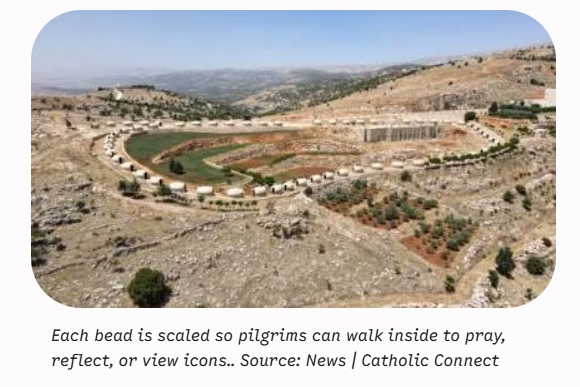
As you step into the first bead chapel, the concrete arch provides shade from the Bekaa sun. The interior walls display scenes corresponding to the Gospel mysteries. The Joyful, Luminous, Sorrowful, or Glorious mysteries depending on the section.
You recite the Hail Mary, step out into the mountain breeze, and walk the path to the next chamber. Repeating this action 59 times over a 600-meter walk creates a physical rhythm that matches the vocal rhythm of the prayer.
The elevation gently rises along the path. So that by the time you reach the 59th bead and stand before the Cross of the Resurrection. You look back across the entire glowing chain winding through the olive groves and terraced hills below.
A Unique Landmark in Sacred Architecture
Lebanon is renowned for its dramatic hillside religious landmarks. From the massive statue of Our Lady of Lebanon in Harissa to the ancient monasteries carved directly into the cliffs of the Qadisha Valley.
The walk-through Rosary of Deir El Ahmar represents a modern chapter in this centuries-old tradition. It fuses structural engineering with centuries-old spiritual practice, creating an enduring space where art, architecture, and personal devotion meet.
Ultimately, the Rosary of Lebanon stands as a physical witness to a gospel that radically elevated the dignity of every individual. Drawing inspiration from the way Jesus consistently championed and honored women's rights. In a culture that often marginalized them. By honoring the Mother of Christ through a monumental space designed for reflection, community, and peace, this walk-through sanctuary serves as a living reminder of those timeless values. Offering a quiet, open space where visitors of all backgrounds can reflect on equalit. With compassion, and the transformative power of faith in action.