In the autumn of 1919, three women sat down together in Tokyo with a simple but radical goal: they wanted Japanese women to be allowed to attend a political meeting without breaking the law. That conversation became the Shin Fujin Kyōkai — the New Women's Association (NWA) — one of the most consequential, if short-lived, organisations in the history of Japanese feminism.
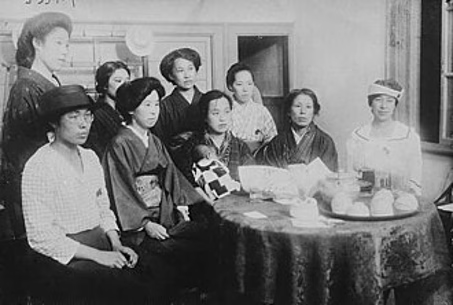
To understand why the NWA mattered, it helps to understand what women in Japan couldn't do in 1919. Under Article 5 of the Peace Police Law, enacted in 1900, women were legally barred from joining political organisations or even attending political meetings (Hunter, 1984; Mackie, 2003). It didn't matter how educated, wealthy, or politically minded a woman was — the law treated her the same as a minor or a person under criminal restraint when it came to public political life.
This was the backdrop of the Taishō era (1912–1926). A period often remembered as more liberal and cosmopolitan than the militarist decades that followed. Newspapers, universities, and literary circles were opening up to new ideas from abroad. A generation of Japanese women educated in the Meiji reforms were beginning to ask why none of that liberalisation extended to them politically.
The NWA's founding can't really be separated from where Japan stood internationally in 1919 and 1920. Japan had joined the Allies in the First World War and emerged from it in an unusually strong position: it had gone from a debtor nation to a creditor one. Its industry had expanded to fill wartime demand from its European allies, and it sat at the table as one of the "Big Five" powers at the 1919 Paris Peace Conference (National Diet Library). Tokyo secured a permanent seat on the Council of the League of Nations and took over Germany's former territorial holdings in Shandong and the Pacific — tangible proof, to many Japanese leaders, that their country had arrived as a great power.
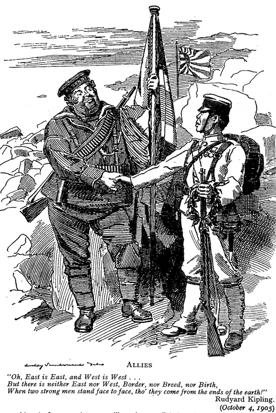
At the same time, that arrival came with a pointed insult. At Paris, the Japanese delegation proposed a racial equality clause for the League of Nations Covenant, asking the other powers to affirm the equal treatment of nationals regardless of race. The clause was rejected, chiefly by the United States, Britain, and Australia (University of Colorado Boulder, n.d.). It was a stinging reminder that formal great-power status did not translate into being treated as an equal by the Western powers — a grievance that lingered in Japanese politics for years afterward, manifesting as a colonial mission in East Asia.
Domestically, this was also the high-water mark of what's now called Taishō Democracy. Hara Takashi had become Japan's first commoner prime minister in 1918 and the first to lead a genuine party cabinet, a real if partial shift of power away from the old Meiji oligarchs (the genrō) and toward elected parties in the Diet (National Diet Library, n.d.). Postwar pacifism was in the air — Emperor Taishō issued an ordinance in January 1920 urging citizens to build on the peace — and Japan would go on to join the United States and Britain at the Washington Naval Conference (1921–1922) in an era of relative great-power cooperation (Nippon.com, 2026). Universal male suffrage, removing property qualifications for men, was still five years off; it wouldn't pass until 1925.
So the NWA was organising in a genuine, if narrow, opening: a Japan that was simultaneously flexing new international muscle, experimenting with party democracy at home, and mixing progressive reform with unresolved imperial ambitions in Korea and China. It's also worth noting the international feminist backdrop the NWA's founders were watching closely. Britain had granted the vote to some women in 1918 and the United States ratified the Nineteenth Amendment in August 1920 — right in the middle of the NWA's own campaign. Ichikawa herself would travel to the United States in 1921 to study the American suffrage movement directly under Alice Paul, before returning to found the Women's Suffrage League in 1924.
Japanese activists were acutely aware they were latecomers to a movement already winning victories abroad, and that comparison was itself a rhetorical tool: if Britain and America could extend the franchise, why not Japan, a nation now claiming a seat among the great powers?
The NWA's founding is often traced to a specific date: January 6, 1920, when Hiratsuka Raichō, Ichikawa Fusae, and Oku Mumeo gathered at Hiratsuka's residence to draft their founding petitions (Molony, 2000; Loftus, 2004). Hiratsuka was already a well-known figure — she had helped found Seitō (Bluestocking), Japan's first literary magazine run entirely by women, and had spent the previous decade arguing publicly for women's individuality and self-determination (Tomida, 2004). She recruited Ichikawa, a young journalist and former teacher, to help build a more overtly political organisation, and the two were joined by Oku Mumeo, a labor activist (Loftus, 2004).
At that January gathering, the group drafted two petitions to bring before the Diet. The first sought to strike the word "women" from the sections of Article 5 that barred them from political organising and attendance at political meetings. The second was aimed at public health and marriage: it called for men to be tested for venereal disease before marrying, and for wives to be able to divorce husbands who concealed such infections (Molony, 2000). It's a reminder that the NWA's feminism wasn't narrowly electoral — it treated women's bodily autonomy and legal protection within marriage as part of the same fight as political rights.

A detail that has stuck in the historical memory: Oku Mumeo, who had recently given birth, would bring her infant son to NWA meetings strapped to her back, using his pram to haul stacks of the organisation's journal, Josei Dōmei (Women's League), around Tokyo (Loftus, 2004). It's a small image, but it captures something true about the movement; it was organising done in the middle of ordinary, exhausting life.
The NWA didn't rely on Tokyo alone. Ichikawa drew on contacts from her earlier work in journalism and labor organising to recruit members well beyond the capital, and the organisation eventually grew to more than thirty branches across the country (Mackie, 2003). That network mattered enormously for a group whose main tool was the petition — the more members and branches behind a document, the harder it became for the Diet to dismiss it as the concern of a small circle of elite Tokyo women.
The petitions went to both houses of the Diet — the House of Representatives and the House of Peers. The first attempt, in 1920, didn't succeed. But the NWA regrouped, and in 1921 it submitted revised petitions, this time adding a more explicit demand for women's suffrage to the platform. That year, the petition to amend the second paragraph of Article 5 — the clause barring women from attending political meetings — was actually adopted by both houses (Orii, 2006; Mackie, 1996).
The final push came down to the wire. On March 25, 1922 — the last day of the 45th Diet session — the revision to Article 5 was secured (Loftus, 2004), lifting the ban on women's attendance at political meetings, though it stopped short of granting women the vote or the right to join political parties outright. It was a partial victory, but a real one — the first legislative crack in a wall that had stood, legally, since 1900.
The NWA didn't survive its own success by much. Ichikawa had already left the organisation in 1921 to study in the United States. Resigning her leadership position after an earlier attempt to revise Article 5 had stalled (Loftus, 2004; Orii, 2009). Hiratsuka's departure followed soon after — years of running the association's office out of her own home had left her suffering headaches, vomiting, and exhaustion, and she withdrew from Tokyo to recover, leaving Oku Mumeo, working alongside fellow member Sakamoto Makoto, to lead the final push on Article 5 (Loftus, 2004; Orii, 2009).
Beyond the toll of overwork, there was also a genuine difference in vision among the founders: Hiratsuka had increasingly come to see the association's real purpose as challenging the double standard of sexual morality, while others were more focused on securing the Article 5 win and moving on (Orii, 2009). Oku Mumeo formally dissolved the New Women's Association on December 8, 1922 (Loftus, 2004). All told, the NWA existed for barely three years.
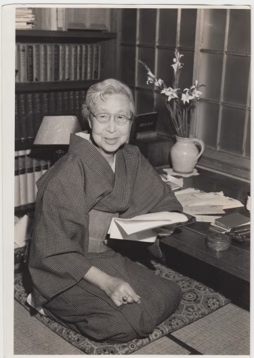
But its influence outlasted its short institutional life by decades. The amendment to Article 5 was, by most historical accounts, the NWA's doing. It stood as proof that organised petitioning could move the Diet on women's issues — a lesson the next generation of activists took seriously (Komori, 2007; Garon, 1997). Ichikawa herself went on to found the League for Women's Suffrage (Fusen Kakutoku Dōmei) in 1924. Building directly on the coalition and tactics the NWA had pioneered. Other women's organisations sprang up in the NWA's wake throughout the 1920s, many explicitly citing it as inspiration.
Full women's suffrage in Japan didn't arrive until 1946, in the aftermath of the Second World War — a full quarter-century after the NWA disbanded. Ichikawa Fusae, remarkably, was still active in politics by then and would go on to serve in the House of Councillors for decades. It's worth sitting with that timeline: the women who forced open the first legal crack in 1922 mostly did not live to see full suffrage granted, and the ones who did had to wait through an entire generation of setbacks, war, and a hardening political climate before it came.
The New Women's Association is easy to overlook in broader accounts of global suffrage movements, which tend to center Britain and the United States. But its story is a useful corrective to a common assumption. That feminist organising in interwar Japan was either non-existent or purely imported from the West. The NWA was homegrown, tactically savvy, and clear-eyed about the limits of what it could win in any single legislative session. It fought for an inch, in the form of one amended clause in one law, and took it.
That incrementalism is, in a way, the most instructive part of the story. The NWA never got to see women vote. What it got was the right for women to sit in a room and talk politics without breaking the law — and it understood, correctly, that this was the precondition for everything that came after.

© Vanessa Ladhar 2026, maj is thinking | everyday anthropology
Unearthing the Suffragette Spirit Project
Garon, S.M. (1997) Molding Japanese Minds: The State in Everyday Life. Princeton: Princeton University Press.
Hunter, J. (1984) Concise Dictionary of Modern Japanese History. Berkeley: University of California Press.
Komori, N. (2007) 'The "hidden" history of accounting in Japan: a historical examination of the relationship between Japanese women and accounting', Accounting History, 12(3), pp. 329–358.
Loftus, R.P. (2004) Telling Lives: Women's Self-Writing in Modern Japan. Honolulu: University of Hawai'i Press.
Mackie, V. (1996) 'Feminist critiques of modern Japanese politics', in Threlfall, M. (ed.) Mapping the Women's Movement: Feminist Politics and Social Transformation in the North. London: Verso, p. 263.
Mackie, V. (2003) Feminism in Modern Japan: Citizenship, Embodiment and Sexuality. Cambridge: Cambridge University Press.
Molony, B. (2000) 'Women's rights, feminism, and suffragism in Japan, 1870–1925', Pacific Historical Review, 69(4), pp. 639–661.
National Diet Library (n.d.) Taishō Democracy: Outline. Available at: https://www.ndl.go.jp/modern/e/cha3/index.html
Nippon.com (2026) The Rise and Fall of Taishō Democracy: Party Politics in Early-Twentieth-Century Japan. Available at: https://www.nippon.com/en/in-depth/a03302/
Orii, M. (2006) Shinfujin Kyōkai no Kenkyū [A Study of the New Women's Association]. Tokyo: Domesu Shuppan.
Orii, M. (2009) Shinfujin Kyōkai no Hitobito [People of the New Women's Association]. Tokyo: Domesu Shuppan.
Tomida, H. (2004) Hiratsuka Raichō and Early Japanese Feminism. Leiden: Brill.
University of Colorado Boulder (n.d.) Meiji and Taishō Japan: An Introductory Essay. Available at:https://www.colorado.edu/ptea-curriculum/becoming-modern/meiji-and-taisho-japan-introductory-essay
