Lady Constance Lytton was a fearless suffragette that cast aside health concerns, societal expectations and financial security in order to embody and advocate for working class women. Born into aristocracy, her path into suffragism was unexpected yet not inconceivable given the experiences of her early life. Lytton’s father was a successful diplomat, meaning her childhood occurred abroad in Vienna, Lisbon, Paris and India. Therefore, Lytton’s view of the world was wide; she interacted with people from a multiplicity of cultures and observed how experiences differ around the globe. Such a childhood ignited a passion for journalism, which was quickly put out by the constraints of her gender and upper-class position.
Forced to place her journalistic ambitions aside, Lady Constance Lytton dutifully moved to Paris with her family, in order to support her father’s career. However, in 1891 Lord Lytton passed away leaving behind a string of bad investments and scandalous debts that plunged the family into treacherous financial circumstances, which were eventually rectified by Constance Lytton’s uncle. These early experiences fractured Lytton’s aristocratic existence and in these gaps qualities such as empathy and social awareness grew.
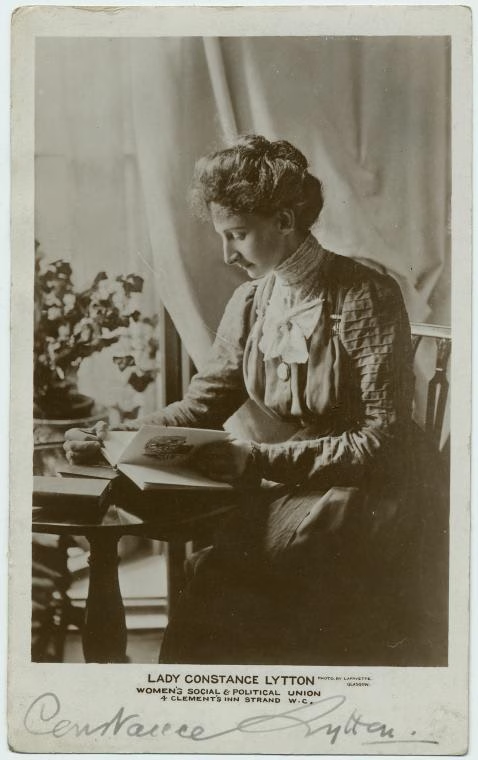
Compassionate qualities were combined with a daring desire to escape the upper-class spinsterhood, that Lytton appeared hopelessly destined for. A letter correspondence between Lytton and her cousin Adela Villiers, revealed that she was desperately in love with a man named John Ponsonby, who she met during her stay in South Africa in 1893. However, the suitor’s limited financial means and Lytton’s constraining duty as her mother’s carer, eradicated any chance of a marital union. Thus, Lytton was frustratingly aware of the lack of autonomy she held over her own life, solely because she was born a woman.
On the 24th of February 1909 Constance Lytton decided to act upon these frustrations and participate in her first militant act as a member of the Woman’s Social and Political Union. Whilst taking part in a deputation to the House of Commons, Lytton was roughly arrested by a policeman who ‘squeeze[d] the remaining breath out of [her] body, and lift[ed] [her] up completely into the air’ (Lytton, 1914).
In October of 1909 Lytton was again arrested, for throwing a stone at a car within which Lloyd George was travelling. Prisons and Prisoners: Some Personal Experiences, Lytton’s autobiography, details her ghastly experiences of Holloway Prison. The absence of privacy and debasement of basic human dignity particularly troubled Lytton, who wrote that, ‘on the passage side of the [cell] door… a bit of wood could be turned aside, like a flap over a keyhole, for the wardens and others to take a look at the prisoner, unobserved, whenever they chose’ (Lytton, 1914).
Despite enduring inhumane imprisonment Lytton was frustratingly aware of the preferential treatment she received on account of her aristocratical position and political connections; her brother was a member of the House of Commons. Whilst imprisoned Lytton attempted to go on hunger strike but was quickly medically examined and released on account of her weak heart. During her recouperation at home she learnt of the harrowing experiences of two lower class suffragettes, Selina Martin and Leslie Hall. Both women were remand prisoners, meaning it was against the law to forcibly feed them, despite this the women were kept in chains by night and forcibly fed by day. Upon reading this in Votes for Women, the WSPU’s newspaper, Lytton vowed to experience and expose the unjust nature of the British penal system.
After chopping her hair and disguising herself in cheap clothes Lytton re – enlisted in the WSPU under the pseudonym Jane Warton. When Jane Warton was arrested, she was forcibly fed with no prior examination of her heart or pulse. The autobiography, which lists Constance Lytton and Jane Warton as its authors, intensely details the force feeding and Lytton comments that ‘the horror of it was more than [she] [could] describe’. Lytton endured force feeding a further seven times before her identity was realised and she was released.
This ordeal had terminal effects on Lytton, who suffered a severe stroke in 1912 and ongoing ill health until her death in 1923, aged 54. Despite this Lytton remained eternally grateful for what she endured describing the reward as ‘undeservedly great’ in a letter to a friend. Lytton’s genius combination of upper-class status with a firsthand experience of imprisonment as a working-class suffragette, made for advocacy that was politically ahead of its time. In 1910, Lytton utilised her aristocratic status to write an article in Votes for Women and deliver a speech at Queen’s Hall, both describing genuine anecdotes of lower-class imprisonment. The result was powerful imagery of the working-class suffragette’s strife, imagery which informed Suffrage novels such as Suffragette Sally, by Gertrude Colmore and No Surrender by Constance Maud.
© Mary Ruck 2026
Unearthing the Suffragette Spirit Project
Lytton, C.L. (2025). Prisons & prisoners. Anson Street Press.
Myall, M. (1998). “Only be ye strong and very courageous” the militant suffragism of Lady Constance Lytton. Women’s History Review, 7(1).
Gertrude Colmore (1911). Suffragette Sally. London: Stanley Paul & Co
