
The Sovereignty of the Individual: Bill of Rights and the Worldwide Franchise
I. The Bill of Rights: The Essential Shield of the Franchise
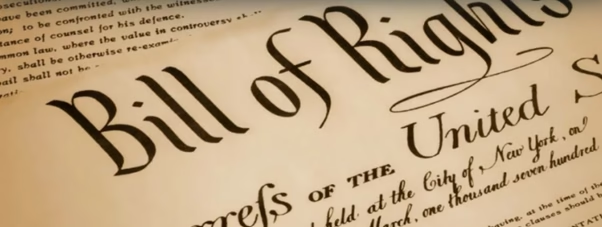
The original U.S. Constitution was a "top-down" document focused on the efficiency of the state. It was the Anti-Federalists—the early champions of grassroots accountability—who argued that a government without a Bill of Rights was merely a sophisticated tyranny.
1. The First Amendment: The Oxygen of the Franchise
The right to vote is meaningless without the right to speak. The First Amendment provides the structural environment necessary for a political franchise to exist.
-
Freedom of the Press: Allows for the "Light of Truth" (as Ida B. Wells described it) to be turned upon the government. Without an informed electorate, the franchise is a blind instrument.
-
Freedom of Assembly: This is the bedrock of The People’s Hub Community. It allows for the "Suitcase Trains" and "Global Gatherings" that sew the needle of history. It proves that the franchise is not just a solo act in a voting booth, but a collective movement.
2. The Fourth and Fifth Amendments: The Privacy of Sovereignty
A franchise exercised under surveillance is not a free franchise. The protection against "unreasonable searches and seizures" ensures that the citizen has a private sphere where their political thoughts and associations are safe from state reprisal. In the modern era, this extends to Digital Sovereignty—the right to keep our digital footprint from being used as a tool of political suppression.
3. The Ninth and Tenth Amendments: The "Reserved" Power
These are the most "People-Centric" parts of the Bill of Rights. They state that any power not explicitly given to the federal government belongs to the People. This is the ultimate check on the "System." It suggests that the franchise is not a gift from the government, but an inherent property of the human being.
II. The Commonwealth Tradition: The Common Weal vs. The Crown
The American Bill of Rights did not emerge in a vacuum; it was the culmination of a Commonwealth struggle that began centuries earlier in the British Isles.
1. Magna Carta and the 1689 Bill of Rights
The "Common Weal" (the common good) was a radical concept that challenged the "Divine Right of Kings." The 1689 English Bill of Rights served as the direct template for the American version. It established that the King could not suspend laws or levy taxes without the consent of the "People’s" representatives.
2. The Levellers and the "Agreement of the People"
During the English Civil War, the Levellers—the true ancestors of modern grassroots activists—proposed a "franchise of the commoner." They argued that every man who had a "breath of life" should have a say in the laws that governed him. While they were suppressed by Oliver Cromwell, their ideas crossed the Atlantic and became the "ghost in the machine" of the US Constitution.
III. The Bavarian Illuminati: The Meritocracy of the "Enlightened" Franchise
Few organizations are more apparently misunderstood than the Bavarian Illuminati. Founded in 1776 by Adam Weishaupt, their goal was not "world domination" in the cinematic sense, but the total accountability of power.
1. The Franchise of Reason
The Illuminati believed that the traditional franchise—based on land ownership or royal blood—was an "obsolete system." They proposed a Meritocracy of Reason. In their view, only those who had educated themselves and freed their minds from religious and political dogma were fit to guide the "Common Weal."
2. The Secret Ballot and the Shadow Franchise
Because the Illuminati operated in a world of absolute monarchs, they had to use secrecy to protect their "franchise." This created a paradox: they sought a world of "Universal Light" but had to operate in "Total Shadow."
In the early American Republic, the "Illuminati Scare" of 1798 was used by the Federalists to attack Thomas Jefferson. They claimed that the "People’s Hubs" (Democratic-Republican Societies) were front organizations for Illuminati radicals. This highlights a recurring theme in history: whenever the People organize for a broader franchise, the "System" labels them as a dangerous conspiracy.
IV. Systemic Accountability: The Rutkovsky Perspective
As Dr. LeeAnn Teal Rutkovsky has argued in the context of fast fashion, we must move beyond "optics" and toward "structural reform." This logic applies perfectly to the political franchise.
-
Fast Politics vs. Sustainable Governance: Just as "Fast Fashion" uses low-cost labor and disposable materials, "Fast Politics" uses soundbites and "selective accountability" to keep the electorate distracted.
-
The Franchise as a System: The right to vote is the "parcel delivery" of democracy. But if the design, finance, and marketing of the political system are controlled by a few, the "parcel fee" (the vote) doesn't change the environmental or social harm of the system.
V. The People’s Hub: The Modern Franchise in Action
At The Peoples Hub community, we see the modern evolution of the franchise. It is no longer just about a ballot box every four years; it is about Continuous Participation.
1. The Suitcase Trains and Material Rights
Projects like the "Suitcase Trains" are a form of Material Franchise. They assert that a person’s right to dignity and mobility is a fundamental "Bill of Right" that must be protected by the community when the state fails.
2. Resera and Economic Sovereignty
By supporting survivor-led social enterprises like Resera, we are exercising an Economic Franchise. We are voting with our currency to build a system where the "shards" of a broken life are rearranged into a beautiful, sustainable pattern.
VI. Synthesis: The Unbroken Chain of Liberty
When we connect the Bill of Rights to the Illuminati’s quest for reason and the Commonwealth’s focus on the 'common good', we see beyond, we see the people and a single, unbroken chain of human effort.
-
The Goal: The perfection of the individual and the accountability of the collective.
-
The Tool: The Political Franchise (Voting, Speaking, Assembling, Buying).
-
The Shield: The Bill of Rights (Protecting the individual from the "System").
Conclusion: Beyond the Edges of Policy
The political franchise is not a "country" or a "party"—it is a System. Until our policies confront the core of that system—moving beyond the "optics" of the vote toward the Binding Responsibility of the representative—we will continue to regulate at the edges.
The Bill of Rights was our first attempt to "regulate the core." It remains our most powerful tool for turning the "Light of Truth" on the structures that seek to outsource our freedom.